
Fossil Synapsids for Sale
Fossil Synapsids for Sale. Synapsids are an extremely important part of the fossil record because they document the evolution of many of the distinctive features of mammals.
They were more closely related to mammals than to the other members of the amniote clade, such as reptiles and birds. Probably the most recognized Synapsid is the Dimetrodons from the Permian Period.
We have a nice selection of Permian Period fossil synapsids for sale.
Buy Fossils from Prehistoric Fossils with Confidence. Your TRUSTED SOURCE since 1997. Authenticity Guaranteed.
Showing 1–50 of 235 results
-
Sold out!
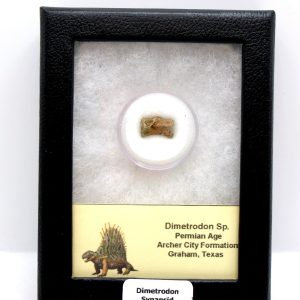
Dimetrodon Synapsid Vertebra #1
$45.00 -
Sold out!
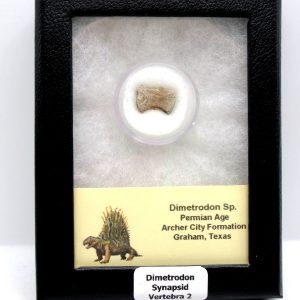
Dimetrodon Synapsid Vertebra #2
$45.00 -
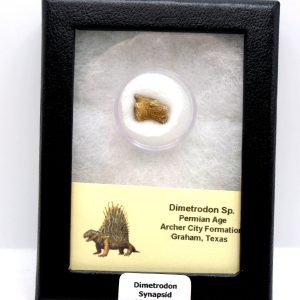
Dimetrodon Synapsid Vertebra #3
$45.00 -
Sold out!
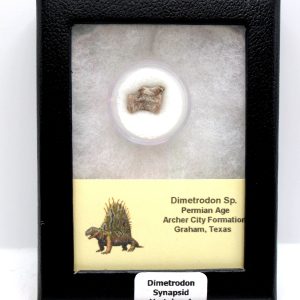
Dimetrodon Synapsid Vertebra #4
$45.00 -
Sold out!
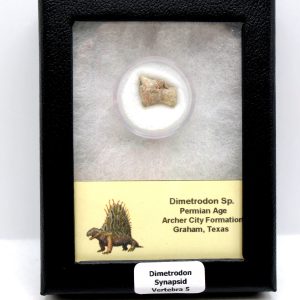
Dimetrodon Synapsid Vertebra #5
$45.00 -
Sold out!
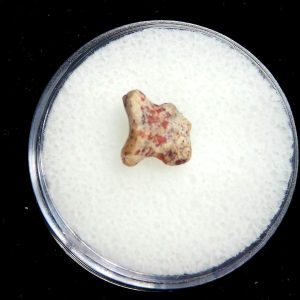
Edaphosaurus Permian Age Synapsid Bone for Sale from Texas #1 – .32″
$12.00 -
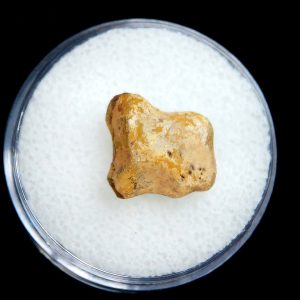
Edaphosaurus Permian Age Synapsid Bone for Sale from Texas #2 – .44″
$15.00 -
Sold out!
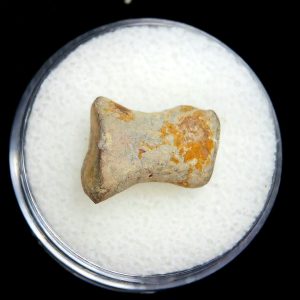
Edaphosaurus Permian Age Synapsid Bone for Sale from Texas #3 – ..55″
$15.00 -
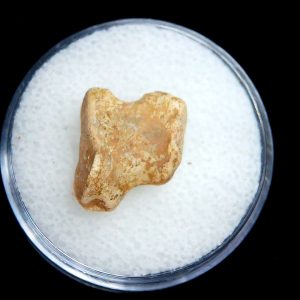
Edaphosaurus Permian Age Synapsid Bone for Sale from Texas #4 – .51″
$15.00 -
Sold out!

Thrausmosaurus Permian Synapsid #21
$20.00 -
Sold out!

Thrausmosaurus Permian Synapsid #22
$20.00 -
Sold out!

Thrausmosaurus Permian Synapsid #23
$20.00 -

Thrausmosaurus Permian Synapsid #24
$65.00 -

Thrausmosaurus Permian Synapsid #25
$35.00 -
Sold out!
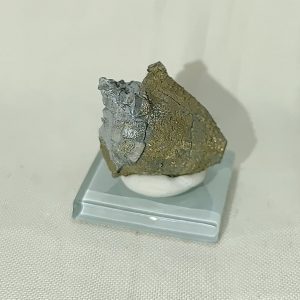
Indiana Waldron Shale Crinoid Calyx #17
$7.50 -
Sold out!

Permian Casea Claw #2
$295.00 -
Sold out!

Dimetrodon Synapsid Tooth #2
$200.00 -
Sold out!

Dimetrodon Synapsid Tooth #4
$215.00 -
Sold out!

Dimetrodon Synapsid Tooth #6
$210.00 -
Sold out!

Dimetrodon Synapsid Tooth #8
$210.00 -
Sold out!
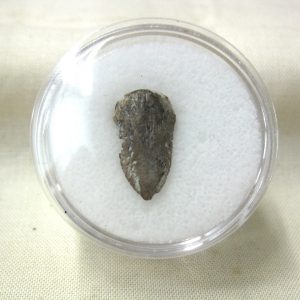
Edaphosaurus Claw #1
$325.00 -
Sold out!
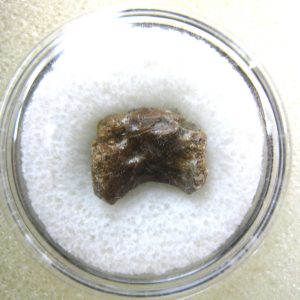
Edaphosaurus Vertebrae #3
$45.00 -
Sold out!
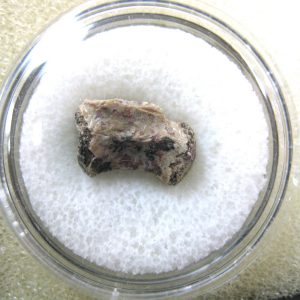
Edaphosaurus Vertebrae #4
$45.00 -
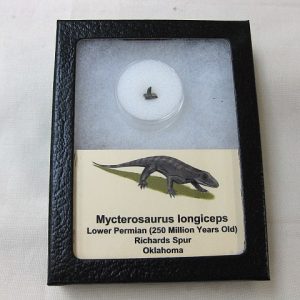
Mycterosaurus longiceps Jaw Section #1
$35.00 -
Sold out!
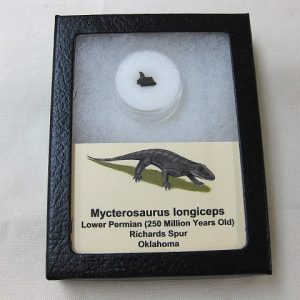
Mycterosaurus longiceps Jaw Section #2
$35.00 -
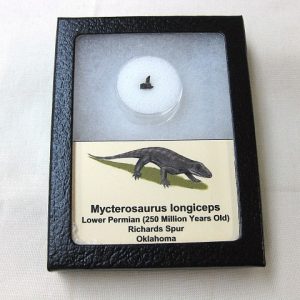
Mycterosaurus longiceps Jaw Section #3
$35.00 -
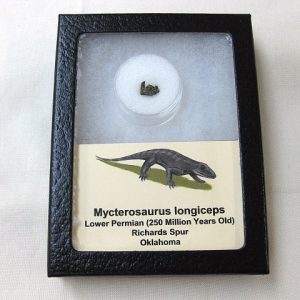
Mycterosaurus longiceps Jaw Section #4
$45.00 -
Sold out!

Mycterosaurus longiceps Jaw Section #5
$45.00 -
Sold out!

Mycterosaurus longiceps Jaw Section #7
$10.00 -

Mycterosaurus longiceps Vertebrae #1
$25.00 -
Sold out!
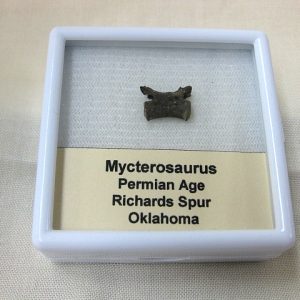
Mycterosaurus longiceps Vertebrae #3
$25.00 -

Mycterosaurus longiceps Vertebrae #4
$45.00 -

Mycterosaurus longiceps Vertebrae #5
$45.00 -

Mycterosaurus longiceps Vertebrae #6
$55.00 -
Sold out!

Mycterosaurus longiceps Femur #1
$45.00 -

Mycterosaurus longiceps Vertebrae #8
$65.00 -

Mycterosaurus longiceps Vertebrae #11
$55.00 -

Mycterosaurus longiceps Vertebrae #12
$55.00 -

Mycterosaurus longiceps Vertebrae #13
$75.00 -

Mycterosaurus longiceps Vertebrae #14
$75.00 -

Mycterosaurus longiceps Vertebrae #15
$75.00 -

Mycterosaurus longiceps Vertebrae #16
$75.00 -

Mycterosaurus longiceps Vertebrae #17
$125.00 -

Mycterosaurus longiceps Vertebrae #18
$25.00 -

Mycterosaurus longiceps Vertebrae #19
$25.00 -

Mycterosaurus longiceps Vertebrae #20
$25.00 -

Mycterosaurus longiceps Vertebrae #21
$25.00 -

Mycterosaurus longiceps | Claw #1
$50.00 -

Mycterosaurus longiceps | Claw #2
$150.00 -

Mycterosaurus longiceps | Claw #3
$125.00
- Buy Fossils
- Fossils for Sale
- Large Selection
- Great Prices and Great Selection
- Authenticity Guaranteed
- Satisfaction Guaranteed
- Your TRUSTED SOURCE SINCE 1997!
- Many more videos are available on our YouTube Channel.
Fossil Synapsids: The Scientific Bridge Between Reptiles and Mammals
Synapsids are a major clade of vertebrates that represent the evolutionary lineage leading to modern mammals. Fossil synapsids provide critical insight into the anatomical, physiological, and ecological transitions that occurred from the Late Carboniferous through the Early Jurassic periods.
Introduction to Synapsids
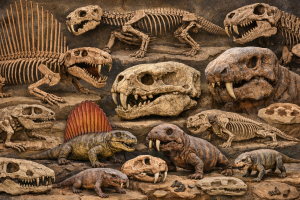
Synapsids are amniote vertebrates distinguished by a single temporal opening in the skull behind each eye orbit. This defining feature separates them from diapsids (dinosaurs, reptiles, birds) and anapsids. Contrary to common misconceptions, synapsids are not reptiles, but rather the direct ancestors of mammals.
The synapsid lineage originated approximately 320 million years ago during the Late Carboniferous period and diversified extensively throughout the Permian and Triassic eras.
Defining Characteristics of Fossil Synapsids
Cranial Anatomy
- Single temporal fenestra enabling stronger jaw musculature
- Progressive differentiation of teeth (heterodonty)
- Enlargement of dentary bone over evolutionary time
Postcranial Adaptations
- Gradual shift from sprawling to semi-upright limb posture
- Increased spinal flexibility
- Rib cage modifications associated with advanced respiration
Physiological Trends
- Evidence suggests increasing metabolic rates
- Development of secondary palate in advanced therapsids
- Early indications of endothermy in late synapsids
Major Groups of Fossil Synapsids
Pelycosaurs (Early Synapsids)
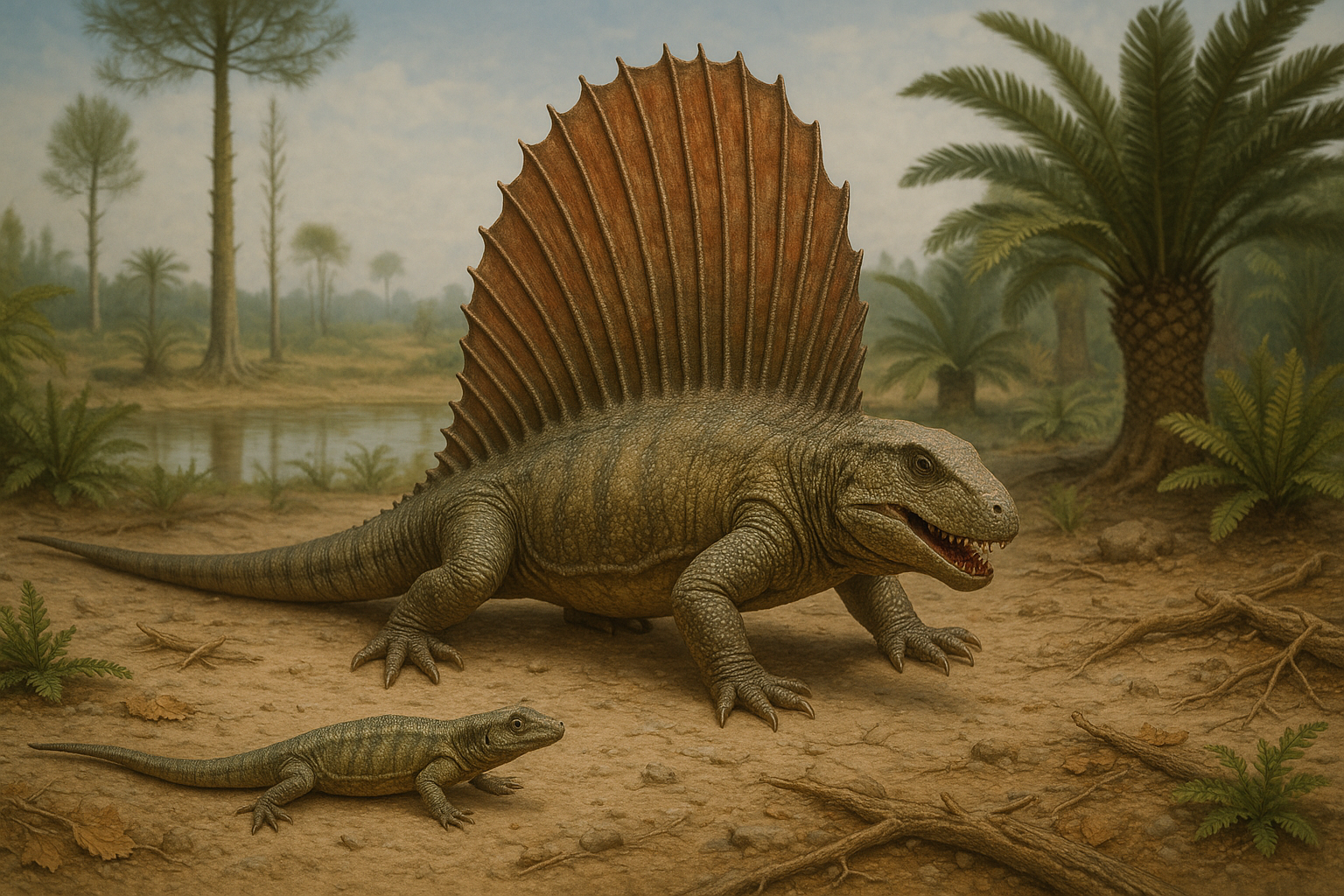
Pelycosaurs dominated terrestrial ecosystems during the Early Permian. The most famous genus, Dimetrodon, is often misidentified as a dinosaur but lived over 40 million years before dinosaurs appeared.
Key traits:
- Sail-backed neural spines
- Carnivorous and herbivorous forms
- Primitive jaw articulation
Therapsids (Advanced Synapsids)
Therapsids represent a critical evolutionary radiation and include:
- Biarmosuchians
- Dinocephalians
- Anomodonts (e.g., Lystrosaurus)
- Gorgonopsians
- Cynodonts
Therapsids exhibit increasingly mammal-like traits, including differentiated teeth, reduced skull bones, and improved locomotion.
Cynodonts and the Origin of Mammals
Cynodonts are the closest non-mammalian synapsids to true mammals. Fossil evidence shows:
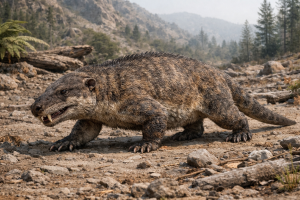
- Nearly complete secondary palate
- Complex postcanine teeth
- Advanced jaw mechanics
By the Late Triassic, early mammals emerged directly from cynodont ancestors.
Geological Time Range and Fossil Record
Fossil synapsids are found globally, with key deposits in:
- South Africa (Karoo Basin)
- Russia
- North America
- China
- South America
They span from the Late Carboniferous (~320 Ma) to the Early Jurassic (~190 Ma), after which mammals diversified.

Scientific Importance of Fossil Synapsids
Evolutionary Biology
Synapsids document one of the most detailed macroevolutionary transitions known:
reptile-like amniotes → mammaliforms → mammals
Functional Morphology
Synapsid fossils reveal:
- Gradual jaw-to-ear bone transformation
- Stepwise acquisition of mammalian chewing
- Progressive cranial simplification
Paleobiology and Climate
Therapsid extinction and survival patterns across the Permian–Triassic mass extinction provide insight into resilience and adaptive radiations following Earth’s most severe extinction event.
Fossil Synapsids and Modern Research
Modern techniques used in synapsid research include:
- High-resolution CT scanning
- Bone histology
- Isotopic analysis
- Digital biomechanical modeling
These methods allow scientists to reconstruct growth rates, metabolism, and even soft-tissue inference in extinct synapsids.