
Bird Fossils for Sale – Bird Fossils and Trace Fossils
Bird Fossils: Rare Evidence of Ancient Bird Evolution
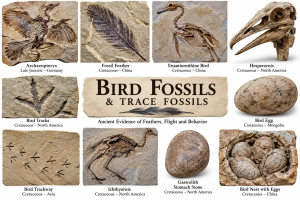
Bird fossils for Sale. Bird Fossils provide scientists with valuable clues about the evolution of modern birds. Birds evolved from small, feathered theropod dinosaurs during the Jurassic Period. However, the bird fossil record remains less complete than that of many animals because bird skeletons contain thin, hollow, and lightweight bones.
Why Are Bird Fossils Rare? Bird Fossils For Sale
Because these delicate bones break easily, complete fossil bird specimens are relatively rare. In addition, scavengers, weather, and moving water can scatter remains before burial. Therefore, rapid burial in fine sediment greatly improves the chance of fossil preservation. Quiet lakes, lagoons, and volcanic ash deposits have produced some exceptional bird fossils.
Archaeopteryx and Early Fossil Birds
For example, Archaeopteryx, from Late Jurassic rocks in Germany, preserves feathers along with teeth, claws, and a long bony tail. Meanwhile, Early Cretaceous deposits in China have produced many remarkable feathered birds and bird-like dinosaurs. These fossils help scientists study the development of feathers, wings, flight, and other important bird features.
Fossil Feathers, Eggs, and Footprints
Furthermore, fossil feathers can preserve fine details that bones cannot reveal. Fossil footprints, eggs, and other trace fossils also provide important evidence about ancient bird behavior, movement, nesting, and environments.
What Bird Fossils Tell Paleontologists
Today, paleontologists compare ancient bird fossils with dinosaurs and living birds. As a result, each discovery can improve our understanding of bird evolution and reveal how birds diversified and survived major environmental changes throughout Earth’s long history.
Showing all 22 results
-
Sold out!

Aepyornis Eggshell Fossil for Sale from Madagascar #25
$15.00 -

Aepyornis Eggshell Fossil for Sale from Madagascar #40
$15.00 -

Aepyornis Eggshell Fossil for Sale from Madagascar #41
$15.00 -

Aepyornis Eggshell Fossil for Sale from Madagascar #44
$15.00 -
Sold out!
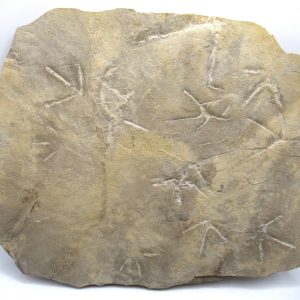
Green River Bird Track Fossil Plate #10
$125.00 -
Sold out!
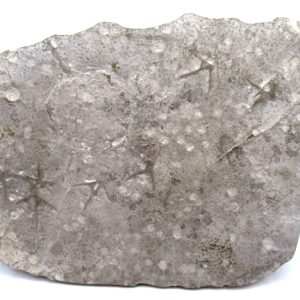
Green River Bird Track Fossil Plate #11
$95.00 -

Green River Bird Track Fossil Plate #4
$65.00 -

Green River Bird Track Fossil Plate #7
$75.00 -

Green River Bird Track Fossil Plate #8
$85.00 -
Avisaurus archibaldi Bird Tooth #10
$145.00 -

Bird Claw #2
$55.00 -
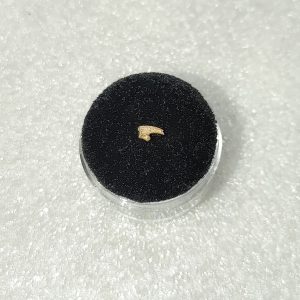
Bird Claw #4
$55.00 -
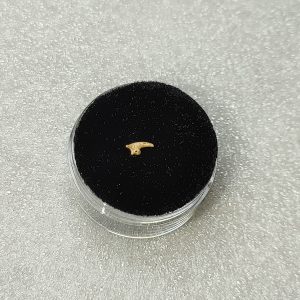
Bird Claw #5
$55.00 -
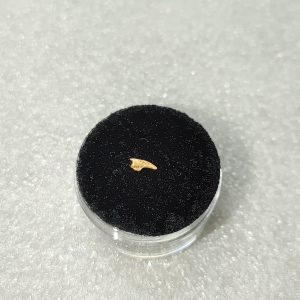
Bird Claw #6
$55.00 -
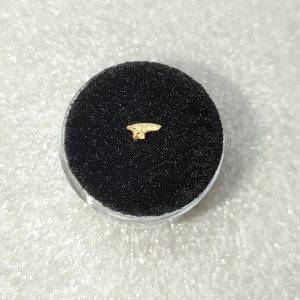
Bird Claw #7
$55.00 -

Bird Claw #8
$55.00 -

Gastornis Egg Shell #24 | Flightless Bird
$17.50 -

Gastornis Egg Shell #26 | Flightless Bird
$17.50 -

Gastornis Egg Shell #32 | Flightless Bird
$17.50 -

Gastornis Egg Shell #33 | Flightless Bird
$17.50 -

Fossil Bird Egg Shell from France #2
$135.00 -

Fossil Bird Egg Shell from France #3
$135.00
- Buy Fossils
- Large Selection
- Great Prices and Great Selection
- Authenticity Guaranteed
- Satisfaction Guaranteed
- Your TRUSTED SOURCE SINCE 1997!
- Many more videos are available on our YouTube Channel.
Bird Fossils for Sale
Why Bird Fossils Matter
Bird Fossils for Sale. Bird fossils provide compelling evidence about the evolution of birds and their close relationship with theropod dinosaurs. They also rank among the more difficult vertebrate fossils to preserve. Because many birds have lightweight, thin-walled bones and delicate skeletons, their remains can break apart or decay before fossilization occurs.
Therefore, every well-preserved discovery can provide valuable scientific evidence about feathers, flight, anatomy, behavior, and the evolutionary history of birds. In recent years, important discoveries have also refined our understanding of avian evolution, showing that many bird characteristics appeared gradually rather than all at once.
What Is a Bird Fossil? Bird Fossils For Sale
A bird fossil is preserved evidence of an ancient bird or its activity. Although fossilized bones are the most familiar examples, the bird fossil record includes several different types of evidence.
Fossil Bird Bones
Bird fossils may preserve skulls, vertebrae, wing bones, claws, hips, legs, and feet. Exceptionally preserved specimens can retain much smaller anatomical structures that help paleontologists study movement, hearing, balance, and flight.
Fossil Feathers
Some fine-grained sedimentary rocks preserve feather impressions and microscopic structures. Exceptionally preserved feathers may reveal details of their shafts, vanes, and melanosomes. Consequently, scientists can sometimes investigate the possible coloration and appearance of extinct birds and feathered dinosaurs.
Soft-Tissue Preservation
Soft tissues rarely fossilize. However, exceptional specimens may preserve evidence of skin, stomach contents, respiratory structures, or other tissues. Such discoveries can provide information that bones alone cannot reveal.
Bird Trace Fossils: Bird Fossils For Sale
Ancient birds also left trace fossils, including footprints, feeding traces, coprolites, eggs, and nesting evidence. These fossils can reveal how birds moved, fed, reproduced, and interacted with their environments.
Since delicate bird skeletons often separate after death, complete specimens are uncommon. As a result, even isolated bones can provide useful scientific information when researchers can identify their anatomy and geological context.
The Oldest Bird Fossils: From Dinosaurs to Birds
Archaeopteryx – Late Jurassic Bird
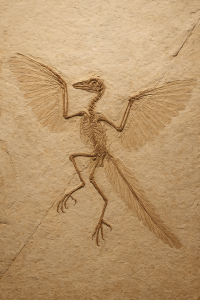 Archaeopteryx, which lived approximately 150 million years ago during the Late Jurassic, remains one of the best-known fossils associated with the early evolution of birds.
It combined several dinosaur-like and bird-like characteristics, including teeth, clawed fingers, a long bony tail, and well-developed feathers. Moreover, its flight feathers had asymmetrical vanes, an important feature associated with aerodynamic function.
Therefore, Archaeopteryx remains important evidence for understanding the evolutionary transition between non-avian theropod dinosaurs and early birds.
Baminornis zhenghensis and New Jurassic Discoveries
Recent fossil discoveries from China continue to refine the timeline of early bird evolution. One important example is Baminornis zhenghensis, a Jurassic avialan discovered in Fujian Province, China.
The fossil displays a combination of primitive and more derived anatomical features. In particular, researchers described evidence of a shortened tail ending in a pygostyle-like structure. This discovery suggests that major changes in tail anatomy were already developing among some Jurassic avialans.
However, paleontological interpretations can change as researchers discover additional specimens and conduct new analyses. Therefore, scientists continue to study how Baminornis fits into the complex evolutionary history of birds.
How Bird Fossils Show the Transition From Dinosaurs
Bird evolution did not occur through one sudden anatomical transformation. Instead, different bird-like characteristics appeared at different stages among theropod dinosaurs and early avialans. Scientists often describe this pattern as mosaic evolution.
Evolution of Feathers
Feathers existed among non-avian dinosaurs before the appearance of modern birds. Early feathers likely served functions such as insulation, display, brooding, or sensory roles. Later, specialized feathers became important components of aerodynamic surfaces and powered flight.
Arms Evolving Into Wings
Over evolutionary time, some theropod lineages developed elongated forelimbs, changes in shoulder mobility, specialized wrists, and feathers suited for aerodynamic use. Together, these changes eventually produced increasingly effective wings.
Changes in Bird Tails
Early avialans such as Archaeopteryx retained long, bony tails. Later bird groups evolved much shorter tails, with the terminal vertebrae fused into a structure called the pygostyle. This structure supports tail feathers that play important roles in flight control, braking, and maneuverability in many living birds.
Evolution of Bird Brains and Senses
Fossil skulls and modern imaging technology allow researchers to reconstruct aspects of ancient bird brains and inner ears. These studies help scientists investigate changes involving vision, balance, sensory processing, and motor control during bird evolution.
Important Bird Fossil Sites Around the World
Solnhofen Limestone – Germany
The Late Jurassic Solnhofen limestones of Germany are famous for exceptional fossil preservation. Most notably, these deposits produced specimens of Archaeopteryx that preserve detailed feather impressions.
Early Cretaceous Fossils of Liaoning, China
Northeastern China has produced an extraordinary variety of feathered dinosaurs and early birds. Fossils from the Early Cretaceous deposits of Liaoning and surrounding areas include Confuciusornis, numerous enantiornithines, and other important avialans.
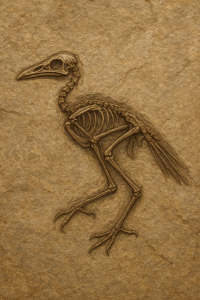 Consequently, these fossil deposits have greatly expanded scientific knowledge of feather evolution, flight, diet, growth, and early bird diversity.
Cretaceous Bird Fossils From Antarctica
Antarctica has also produced important Cretaceous bird fossils. These discoveries demonstrate that diverse birds inhabited high-latitude southern environments while non-avian dinosaurs still lived on Earth.
Bird Fossils From North America and Mongolia
Fossil bones, eggs, footprints, and other evidence from North America and Mongolia continue to broaden our understanding of ancient bird distribution. Together, these discoveries show that early birds occupied diverse habitats across much of the prehistoric world.
What Bird Fossils Reveal About Ancient Bird Life
Ancient Bird Diets
Fossilized stomach contents, pellets, coprolites, beaks, teeth, and digestive remains can provide evidence about diet. Scientists have identified adaptations associated with eating fish, insects, seeds, plants, and other food sources. Therefore, early birds occupied a surprisingly broad range of ecological niches.
Bird Flight Capabilities
Researchers examine feather shape, wing proportions, skeletal anatomy, muscle attachment areas, and joint structure to investigate flight ability. These features can help determine whether an extinct bird was adapted for powered flight, limited aerial movement, gliding, or flightlessness.
Growth and Development
Scientists can examine microscopic structures inside fossil bones through a field called bone histology. Growth lines, blood-vessel patterns, and bone organization provide evidence about how quickly extinct birds grew and matured.
Recent Bird Fossil Discoveries and Research
Discovery of Baminornis
The discovery of Baminornis zhenghensis provided new evidence about the diversification of Jurassic avialans. In particular, its combination of anatomical traits adds important information to scientific discussions about when shortened bird tails evolved.
Fossil Bird Brain Reconstructions
Advanced scanning technology allows researchers to create digital models of the internal spaces of fossil skulls. Fossils such as Navaornis hestiae have provided important evidence for studying how the distinctive brains of modern birds evolved.
Research Into Bird Wrist Evolution
Studies of theropod and bird wrist anatomy continue to reveal how structures associated with wing movement developed through evolutionary time. These fossils help researchers reconstruct the gradual anatomical changes that eventually supported sophisticated avian flight.
Birds Living and Nesting at High Latitudes
Fossil bones, footprints, eggshell fragments, and other reproductive evidence indicate that birds lived in high-latitude environments during the Cretaceous. Such discoveries help paleontologists understand how ancient birds adapted to seasonal environments during the age of dinosaurs.
Why Are Bird Fossils So Rare?
Bird fossil preservation presents several challenges. Many bird bones have thin walls, and skeletons contain numerous small joints that can separate after death. Scavengers, flowing water, weathering, and decomposition can further scatter or destroy remains before sediment buries them.
Feathers and other soft tissues decay even more easily. Therefore, exceptional preservation usually requires favorable conditions, such as rapid burial, low-oxygen environments, volcanic ash, or very fine sediment.
As a result, complete fossil birds with articulated skeletons and preserved feathers can be exceptionally important scientific discoveries.
The Future of Bird Fossil Research
New technologies continue to improve the study of fossil birds. For example, micro-CT scanning can reveal delicate structures hidden inside rock without destroying the specimen. Meanwhile, microscopic and chemical analyses can provide new information about feathers, pigments, diet, and preservation.
In addition, new fossil discoveries from Jurassic and Cretaceous deposits may continue to fill gaps in the bird evolutionary record. Each specimen has the potential to refine our understanding of when important features such as specialized wings, shortened tails, advanced sensory systems, and modern styles of flight appeared.
Bird Fossils and the Evolutionary History of Flight
Bird fossils provide an extraordinary window into the evolutionary history of flight. From Archaeopteryx and other Jurassic avialans to the enormous diversity of Cretaceous birds, fossils document a complex pattern of anatomical change over millions of years.
Because bird remains can be difficult to preserve, exceptionally complete specimens offer particularly valuable information. Together with isolated bones, feathers, eggs, and trace fossils, they help paleontologists reconstruct the anatomy, behavior, ecology, and evolutionary history of ancient birds.
Bird Fossils for Sale at Prehistoric Fossils
Explore bird fossils for sale at Prehistoric Fossils and discover genuine specimens from Earth’s prehistoric past. Fossils can provide collectors, educators, students, and natural history enthusiasts with a tangible connection to ancient life and the evolutionary history of birds.
Buy Fossils with Confidence from Prehistoric Fossils — Your Trusted Source Since 1997. Authenticity Guaranteed.
“`