
Calcite Fairy Stones For Sale | Natural Canadian Concretions
Calcite Fairy Stones For Sale
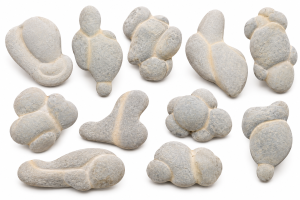
Calcite Fairy Stones For Sale are unusual natural mineral formations valued for their rounded, flattened, and often curious shapes. Some specimens resemble coins, disks, animals, or small figures. Because of these distinctive forms, collectors have enjoyed fairy stones as natural curiosities for generations. However, despite their magical-sounding name, Calcite Fairy Stones form through natural geological processes.
What Are Calcite Fairy Stones?
Calcite Fairy Stones consist largely of calcium carbonate (CaCO3), commonly in the mineral form calcite. They develop as mineral-rich groundwater moves through sediment. As chemical conditions change, calcium carbonate can precipitate around small particles or within layers of sediment.
Over time, additional mineral material accumulates. Consequently, a concretion gradually develops. Differences in sediment, water chemistry, mineral concentration, and growth direction can produce unusual shapes. Therefore, each natural specimen may have a distinctive appearance.
How Do Calcite Fairy Stones Form?
Many Calcite Fairy Stones form in fine-grained sediments associated with ancient lakes, rivers, or glacial environments. First, groundwater carries dissolved calcium and carbonate ions through porous sediment. Then, changing chemical conditions encourage calcite to crystallize. As a result, the growing mineral mass binds nearby sediment together.
Later, erosion may remove the softer surrounding material. Consequently, the harder calcite-rich concretions become exposed. They may then collect along shorelines, streambeds, or other eroded surfaces.
Collecting Calcite Fairy Stones For Sale
Collectors searching for Calcite Fairy Stones For Sale often value them for their natural shapes, smooth surfaces, and geological interest. Moreover, their wide variety of forms makes each specimen visually unique.
Although folklore inspired the charming name “fairy stones,” their true story comes from chemistry, groundwater, sediment, and time. Therefore, Calcite Fairy Stones provide an interesting connection between mineral collecting, natural history, and sedimentary geology.
Showing all 3 results


WHY SHOP WITH PREHISTORIC FOSSILS?
- Large Selection
- Great Prices and Great Selection
- Authenticity Guaranteed
- Satisfaction Guaranteed
- Your TRUSTED SOURCE for 25 years!
- Many more videos are available on our YouTube Channel
Calcite Fairy Stones For Sale | Natural Canadian Concretions
Calcite Fairy Stones For Sale offer collectors unusual natural concretions formed through sedimentary processes, groundwater movement, and calcium carbonate mineralization. These distinctive stones occur most famously in parts of Quebec, Canada. Because each specimen develops naturally, no two fairy stones look exactly alike.
Although their name comes from folklore, Canadian Calcite Fairy Stones have a geological origin. Their rounded, flattened, joined, or unusual shapes developed as minerals slowly cemented sediment together. Therefore, they provide an excellent example of natural concretion formation.
What Are Canadian Calcite Fairy Stones?
Canadian Calcite Fairy Stones are natural concretions that contain calcium carbonate minerals, commonly including calcite, CaCO3. They often form smooth disks, rounded masses, flattened shapes, or complex joined forms. In addition, some specimens appear to resemble animals, people, hearts, or other familiar objects.
However, these unusual forms developed naturally. They are not carved objects, and they are generally not fossils. Instead, groundwater chemistry, sediment structure, and mineral growth controlled their final appearance.
How Do Calcite Fairy Stones Form?
Calcite Fairy Stones formed within soft, mineral-rich sediments. First, groundwater moved through the sediment while carrying dissolved calcium and carbonate ions. Under suitable chemical conditions, calcium carbonate began to precipitate around small particles or natural nucleation points.
As a result, mineral material gradually cemented nearby sediment together. This process created a harder mass called a concretion. Over time, the concretion continued to grow as more minerals accumulated.
Furthermore, differences in groundwater flow, sediment texture, permeability, and available space affected the shape of each stone. Consequently, fairy stones from the same region can show very different forms.
The Role of Calcite in Fairy Stones
Calcite is one of the most common carbonate minerals on Earth. It has the chemical formula CaCO3 and a hardness of about 3 on the Mohs scale. Therefore, it is softer than quartz and may scratch more easily than many common gemstones.
Additionally, calcite reacts with dilute acid because carbonate releases carbon dioxide during the reaction. Geologists often use this reaction as an identification tool. However, collectors should avoid acid testing valuable specimens because acid can damage the natural surface.
Why Do Canadian Fairy Stones Have Unusual Shapes?
The unusual shapes found in Calcite Fairy Stones For Sale developed through natural mineral growth within sediment. For example, variations in sediment density can redirect groundwater around a growing concretion. Likewise, two or more concretions may grow together and create more complex forms.
Later, erosion may remove softer surrounding sediment and expose the harder concretion. Water movement can then smooth portions of the surface. Therefore, many Canadian fairy stones have rounded, sculptural, or almost symmetrical appearances.
Canadian Calcite Fairy Stones and Folklore
The term fairy stone comes from traditional folklore rather than mineral science. Over time, people have associated unusually shaped stones with good fortune, protection, and other cultural beliefs. However, these traditions remain separate from the scientific explanation for how the stones formed.
Scientifically, Canadian Calcite Fairy Stones provide excellent examples of carbonate mineralization, concretion growth, sedimentary geology, and groundwater chemistry. For this reason, they appeal to mineral collectors, educators, students, and natural history enthusiasts.
Collecting Calcite Fairy Stones For Sale
When comparing Calcite Fairy Stones For Sale, collectors often look for unusual shapes, natural surface detail, symmetry, size, and overall condition. Because each specimen formed naturally, every piece displays its own shape and character.
Most importantly, genuine Canadian Calcite Fairy Stones offer a direct connection to the geological processes that shaped their original sedimentary environment. As a result, they make attractive display pieces as well as useful educational specimens for teaching mineralogy and sedimentary geology.