
Sponge Fossils For Sale | Authentic Fossil Sponges
Sponge Fossils For Sale
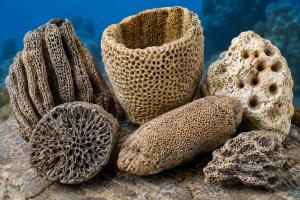
Sponge Fossils For Sale offer collectors a fascinating look into ancient marine life and the history of Earth’s oceans. Fossil sponges belong to the phylum Porifera and have lived in marine environments for more than 600 million years. Because most sponges have soft bodies, complete fossil specimens are uncommon. However, their mineral-rich skeletons can preserve remarkably well under the right conditions.
How Fossil Sponges Form
Many ancient sponges built their skeletons from silica or calcium carbonate. After a sponge died, sediment could quickly cover its remains. Over time, groundwater carried minerals through the buried material. As a result, these minerals could preserve or replace parts of the original skeleton. In some cases, surrounding rock also preserves the sponge’s shape and fine skeletal structure.
What Fossil Sponges Tell Us
Fossil sponges provide valuable evidence for scientists studying ancient seas, reefs, and marine ecosystems. Furthermore, these fossils can offer clues about past water conditions and the environments where ancient sponges lived. Sponge fossils occur in rocks from many different geological periods. Therefore, they can help researchers understand how marine life changed over millions of years.
Collecting Sponge Fossils
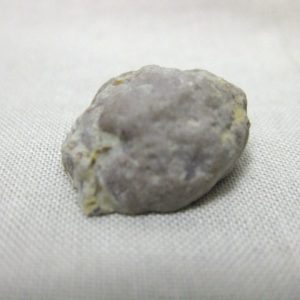
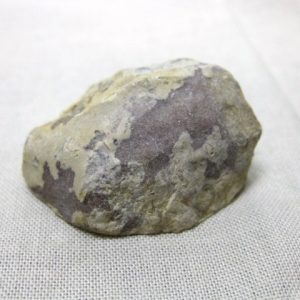
Today, Sponge Fossils For Sale are popular with collectors because of their scientific importance and natural beauty. Well-preserved specimens may display detailed pores, skeletal patterns, and distinctive mineral colors. However, collectors should consider a specimen’s geological age, locality, preservation, preparation, and authenticity when evaluating fossil sponges.
Why Collect Fossil Sponges?
Overall, Sponge Fossils For Sale provide a tangible connection to ancient oceans. Each authentic fossil can offer both visual appeal and valuable evidence of marine life that existed millions of years ago. As a result, fossil sponges can be meaningful additions to educational collections, natural history displays, and serious fossil collections.


- Buy Fossils
- Fossils for Sale
- Large Selection
- Great Prices and Great Selection
- Authenticity Guaranteed
- Satisfaction Guaranteed
- Your TRUSTED SOURCE SINCE 1997!
- Many more videos are available on our YouTube Channel.
Sponge Fossils For Sale: Ancient Architects of Earth’s Earliest Ecosystems
Sponge fossils for sale offer collectors, educators, and fossil enthusiasts an opportunity to explore evidence of some of the earliest multicellular animals in Earth’s history. Fossil sponges, belonging to the phylum Porifera, have a geological record extending back hundreds of millions of years and provide important evidence for the evolution of early animal life, ancient marine ecosystems, reef development, and biological interactions in prehistoric oceans.
Because many sponges possessed mineralized skeletal elements, their remains can sometimes survive long after the soft tissues of the animal disappeared. Today, sponge fossils are valued not only as natural-history specimens but also as educational examples of ancient marine biodiversity and fossil preservation.
What Are Sponge Fossils?
Sponges belong to the phylum Porifera, an ancient group of aquatic animals characterized by porous bodies and a specialized filter-feeding lifestyle. Unlike animals with complex organs and well-developed tissues, sponges have relatively simple body organization while maintaining highly effective systems for circulating and filtering water.
Fossil sponges are preserved remains, impressions, molds, or mineralized skeletal structures produced by ancient sponge organisms. Their fossils are particularly significant because they provide a window into early marine ecosystems and the evolution of animal life.
Why Are Fossil Sponges Important?
The fossil record of sponges helps scientists investigate several major questions in paleontology and evolutionary biology, including:
- The early evolution of multicellular animals
- The diversification of early marine organisms
- The development of ancient reef ecosystems
- The evolution of biological mineralization
- Changes in ancient marine environments
- Patterns of fossil preservation and taphonomy
For collectors, sponge fossils for sale can therefore represent more than attractive specimens. A properly identified fossil can serve as a tangible connection to ancient marine environments and the long geological history of life on Earth.
Evolutionary History and Geological Range of Sponge Fossils
Sponges have an exceptionally long evolutionary history. Fossil evidence and molecular research indicate that sponge lineages are extremely ancient, although the timing and interpretation of the earliest evidence continue to be studied by scientists.
Precambrian Origins
Some of the earliest evidence associated with sponge-like organisms dates to the Precambrian, including the Ediacaran Period, approximately 635 to 541 million years ago. Body fossils from this interval can be difficult to identify with certainty because soft-bodied organisms are rarely preserved in the fossil record.
Geochemical evidence, including studies of ancient organic molecules known as biomarkers, has also contributed to scientific discussions about the antiquity of sponge lineages. Because interpretations of very ancient biomarker evidence remain an active area of research, individual discoveries must be evaluated carefully within their geological context.
Cambrian Diversification
During the Cambrian Period, sponges became important components of increasingly diverse marine ecosystems. Shallow seas provided extensive habitats where early animals could live, interact, and become incorporated into developing ecological communities.
Some Cambrian sponge groups also contributed to early reef-building systems. These ancient reef communities demonstrate that biologically constructed structures existed long before the dominance of many modern coral reef ecosystems.
Paleozoic and Mesozoic Persistence
Sponge lineages persisted through major changes in Earth’s oceans and survived multiple episodes of environmental disruption and mass extinction. Their long geological history illustrates the ecological flexibility of organisms capable of occupying different marine habitats and using different skeletal materials.
Major Types of Fossil Sponges
Sponge fossils are represented by several major groups. Identification may depend on skeletal architecture, microscopic spicules, mineral composition, geological age, and the characteristics of the surrounding rock.
Demospongiae
Demosponges represent the largest class of living sponges and have a substantial fossil record. Their skeletons may contain siliceous spicules and, in many living forms, organic spongin fibers. Fossil preservation can involve replacement, mineralization, impressions, or preservation of individual skeletal elements.
Hexactinellida: Glass Sponges
Glass sponges are distinguished by their characteristic six-rayed siliceous spicules. Fossil hexactinellids are particularly well represented in some marine sedimentary deposits and can occasionally be preserved with remarkable skeletal detail.
The distinctive architecture of glass sponge skeletons makes well-preserved specimens especially interesting to collectors and researchers studying ancient marine environments.
Calcarea
Calcareous sponges produce skeletal elements composed primarily of calcium carbonate. Because carbonate minerals can be altered or dissolved during burial and diagenesis, these fossils may experience different preservation histories from silica-rich sponge remains.
Archaeocyatha
Archaeocyathids were an extinct group of early Cambrian organisms traditionally regarded as sponge-like and important in the development of some of the earliest metazoan reefs. They disappeared relatively early in the Paleozoic, but their fossils remain valuable for understanding early reef environments and Cambrian ecosystems.
How Are Sponge Fossils Preserved?
The preservation of a sponge depends on its skeletal composition, the surrounding sediment, burial conditions, groundwater chemistry, and subsequent geological alteration. As a result, sponge fossils for sale can display substantial differences in color, texture, mineral composition, and three-dimensional preservation.
Silicification
Silicification occurs when silica becomes incorporated into or replaces original fossil material. Under favorable conditions, this process can preserve important structural details of ancient sponge skeletons.
Carbonate Replacement and Preservation
Carbonate-rich sponge material may be preserved directly or altered during burial and diagenesis. In reef and shallow-marine deposits, carbonate minerals can form an important part of the surrounding fossil-bearing rock.
Molds and Casts
When the original skeletal material is dissolved or removed after burial, it may leave an impression in the surrounding sediment. If that cavity is later filled with minerals or sediment, a cast can form. Molds and casts can preserve the overall shape of a sponge even when the original material is no longer present.
Exceptional Fossil Preservation
Rare fossil deposits known as Lagerstätten can preserve delicate organisms and anatomical structures that normally would disappear before fossilization. Exceptionally preserved sponge fossils can provide scientists with information that is unavailable from fragmentary specimens.
Paleoecological Importance of Fossil Sponges
Ancient sponges were important components of marine ecosystems. Their ability to filter water, interact with microorganisms, and occupy hard or soft substrates allowed them to influence local ecological communities.
Ancient Reef Construction
Some sponge groups played important roles in early reef development. Their skeletal structures could contribute to rigid frameworks or help stabilize marine substrates, creating habitats that could subsequently be occupied by other organisms.
The history of sponge reefs demonstrates that reef ecosystems have undergone major changes through geological time. Studying these structures helps paleontologists reconstruct the environmental conditions that supported ancient marine communities.
Water Filtration and Nutrient Cycling
Modern sponges are highly effective filter feeders, and ancient sponge communities likely played important ecological roles in processing seawater. Their interactions with microorganisms and dissolved nutrients may also have contributed to local biogeochemical cycles.
Fossil evidence cannot always reveal the precise ecological function of an extinct sponge, but skeletal morphology, sedimentary context, associated fossils, and geochemical evidence can help researchers reconstruct its ancient environment.
Scientific Significance of Sponge Fossils
Fossil sponges are important research specimens because they connect paleontology, evolutionary biology, sedimentology, geology, and geochemistry.
Understanding Early Animal Evolution
Sponges provide important evidence for studying the early evolution of animals. Their relatively simple organization makes them especially useful for investigating questions about multicellularity, early animal biology, developmental evolution, and the relationships among major animal lineages.
Stratigraphy and Biostratigraphy
Some fossil sponge groups can help paleontologists interpret the age and environmental setting of sedimentary rocks. Their distribution through particular geological intervals can provide useful biostratigraphic information, especially when combined with other fossil evidence.
Modern Research Techniques
Modern paleontological techniques continue to improve the scientific value of fossil sponge specimens. Micro-CT scanning, microscopy, mineralogical analysis, stable-isotope studies, and other geochemical methods can reveal internal structures and chemical histories that are not visible from the surface.
What to Consider When Buying Sponge Fossils
When searching for sponge fossils for sale, buyers should consider more than appearance. A quality fossil specimen should be accompanied by accurate information about its identification, geological origin, locality when appropriate, condition, and any known preparation or restoration.
Authenticity and Restoration
Fossils can sometimes be repaired, reconstructed, stabilized, or restored. Responsible sellers should clearly disclose significant restoration or repairs rather than presenting altered material as completely natural.
Identification and Provenance
Accurate identification is especially important when purchasing uncommon fossil sponges. Useful specimen information may include the fossil group or genus when confidently identified, geological formation or age, geographic locality when legally and ethically appropriate, and details about preparation.
Condition and Display Quality
Natural fractures, mineralization, matrix attachment, and minor imperfections are common characteristics of fossils. Buyers should evaluate whether a specimen’s condition is consistent with its intended purpose, whether for collecting, research, education, or display.
Sponge Fossils For Sale for Collectors and Education
A well-documented sponge fossil for sale can make an excellent addition to a natural-history collection. Fossil sponges can also be useful teaching specimens for classrooms, museums, universities, and educational displays.
Unlike manufactured replicas, authentic fossils provide direct physical evidence of ancient organisms and the geological processes that preserved them. Their unusual forms and mineralized structures can make them particularly engaging examples of prehistoric marine life.
Conclusion: The Legacy of Ancient Sponge Fossils
Sponge fossils for sale provide collectors and educators with an opportunity to own a physical piece of Earth’s deep biological history. From Precambrian evidence of early sponge lineages to diverse Paleozoic and Mesozoic forms, fossil sponges document the long history of marine ecosystems and the evolution of early animal life.
Their scientific value extends beyond their appearance. Fossil sponges can preserve information about ancient environments, skeletal evolution, reef development, mineralization, and ecological interactions. Continued advances in imaging and geochemical analysis will allow researchers to extract even more information from these remarkable fossils.
Whether collected for scientific interest, education, or display, authenticated sponge fossils offer a fascinating connection to the ancient oceans that covered much of our planet’s history.
Buy Fossils with Confidence — Authenticity Guaranteed.