
Viking Artifacts For Sale | Authentic Viking Age Relics
Viking Artifacts For Sale | Authentic Small Viking Artifacts
Viking Artifacts For Sale offer a fascinating connection to everyday life in northern Europe during the Viking Age, roughly AD 750–1050. Although large weapons and ships often receive the most attention, small Viking artifacts can reveal important details about trade, clothing, craftsmanship, warfare, and personal identity.
Small Viking Artifacts and Everyday Life
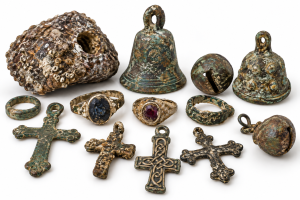
Archaeologists find many small Viking artifacts at settlements, graves, trading centers, and other archaeological sites. For example, common discoveries include brooches, buckles, beads, pendants, rings, coins, keys, combs, spindle whorls, and small tools. In addition, excavations sometimes uncover arrowheads and other pieces of military equipment.
Viking craftspeople worked with iron, bronze, silver, gold, bone, antler, glass, stone, and wood. However, preservation depends greatly on soil conditions and the surrounding environment. Therefore, metal, stone, and bone artifacts often survive better than wood or textiles.
What Viking Artifacts Reveal About Trade
Viking Artifacts For Sale can represent the same types of objects that archaeologists use to study ancient trade networks. For instance, coins, beads, and imported materials show contact between Scandinavia and regions throughout Europe and beyond. Likewise, silver objects and foreign goods provide evidence of travel, commerce, wealth, and cultural exchange.
Viking Jewelry, Tools, and Personal Objects
Small personal artifacts also provide evidence about Viking clothing and skilled craftsmanship. Brooches helped secure garments, while decorated pendants and jewelry could reflect social status, personal identity, or religious beliefs. Moreover, combs made from bone or antler demonstrate the detailed work performed by Viking craftspeople.
Scientific Importance of Viking Artifacts
Because archaeological context matters, researchers carefully record where each artifact appears. As a result, even a tiny object can help date a site or explain how people used a specific area. Therefore, genuine Viking Artifacts For Sale can provide collectors with tangible examples of the materials, technology, trade, and culture associated with Viking Age society more than a thousand years ago.
Showing the single result

- Buy Viking Artifacts
- Viking Artifacts for Sale
- Large Selection
- Great Prices and Great Selection
- Authenticity Guaranteed
- Satisfaction Guaranteed
- Your TRUSTED SOURCE SINCE 1997!
- Many more videos are available on our YouTube Channel.
Viking Artifacts For Sale | Authentic Norse History and Archaeology
Viking Artifacts For Sale offer collectors a direct connection to the Norse world of approximately AD 793–1066. Archaeologists study Viking weapons, jewelry, tools, ships, coins, and household objects to understand Norse technology, trade, religion, and everyday life. As a result, authentic artifacts provide valuable physical evidence of one of medieval Europe’s most influential maritime cultures.
Who Were the Vikings?
 The Vikings were Norse seafarers whose homelands included present-day Norway, Sweden, and Denmark. Although popular culture often portrays them mainly as raiders, archaeology reveals a much broader society. Vikings also worked as farmers, merchants, craftspeople, explorers, warriors, and settlers.
Therefore, the scientific study of Viking artifacts helps researchers move beyond legends and written sagas. Archaeological evidence instead provides a physical record of how Norse communities lived, traveled, traded, and interacted with neighboring cultures.
Archaeological Evidence of Viking Society
Archaeologists have discovered Viking settlements, burials, workshops, ships, and trade goods across Scandinavia, the British Isles, Eastern Europe, Iceland, Greenland, and the North Atlantic. Important archaeological sites include:
- Birka, Sweden – an important Viking Age trading center
- Hedeby, Germany – a major commercial settlement linking northern Europe with distant trade routes
- York, England – extensive evidence of Viking urban settlement and craftsmanship
- L’Anse aux Meadows, Newfoundland – archaeological confirmation of Norse activity in North America
Consequently, these sites show that Viking culture was both regionally diverse and technologically sophisticated.
Viking Artifacts For Sale and Their Scientific Importance
Viking Weapons and Metalworking
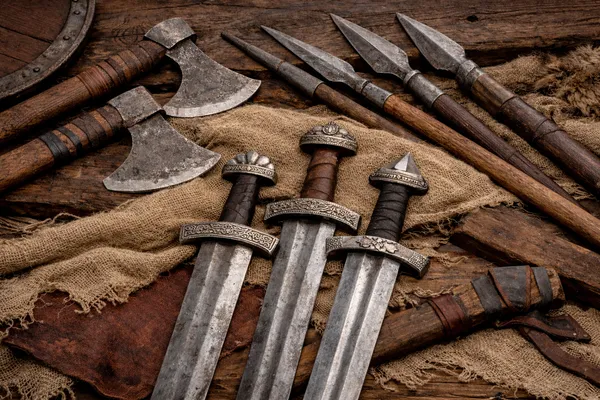 Viking swords, axes, spearheads, arrowheads, and other weapons reveal considerable knowledge of ironworking. Craftsmen forged blades from iron and steel, while some weapons used pattern welding, a method that combined different iron alloys into strong and visually distinctive blades.
Moreover, scientific analysis shows that the composition and quality of Viking Age iron varied greatly. Some high-quality blades contained steel with relatively high carbon content, while imported materials and finished weapons also reached Scandinavia through long-distance trade.
- Pattern welding produced distinctive layered blade structures
- Metal composition varied according to ore source and forging method
- Decorative fittings and inscriptions could indicate status, ownership, or cultural identity
Viking Ships and Maritime Engineering
 Viking ships rank among the best-known achievements of Norse engineering. Excavated vessels such as the Oseberg and Gokstad ships demonstrate advanced woodworking and shipbuilding skills.
- Clinker-built hull construction with overlapping planks
- Strong yet relatively lightweight wooden hulls
- Shallow drafts suitable for rivers, coastlines, and open seas
- Combined use of sails and oars
Furthermore, experimental reconstructions show that Viking ship designs were capable of long ocean voyages. Archaeological evidence from Greenland and Newfoundland confirms that Norse sailors crossed large areas of the North Atlantic centuries before Columbus.
Viking Jewelry, Art, and Symbolism
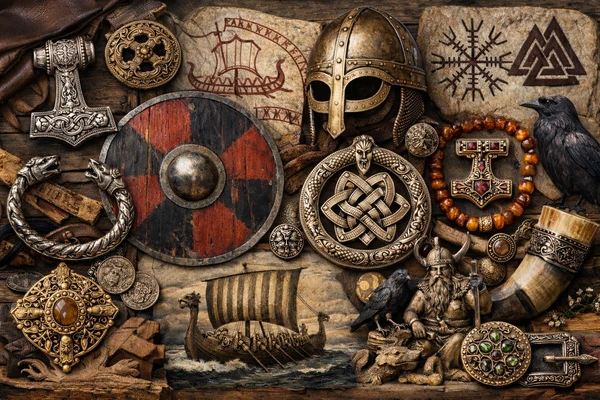 Jewelry represents another important category of Viking Artifacts For Sale. Viking craftspeople worked with silver, bronze, gold, iron, glass, amber, and other materials. Brooches, rings, pendants, beads, bracelets, and amulets can reveal information about wealth, trade, personal identity, and religious belief.
Common designs include:
- Thor’s hammer pendants (Mjölnir)
- Interlaced animals and geometric decoration
- Styles associated with Viking Age traditions such as Jelling, Borre, and Urnes
- Foreign coins and silver adapted into jewelry or ornaments
For example, Islamic silver dirhams found throughout Scandinavia demonstrate far-reaching economic contacts. Scientific analysis of metals and archaeological contexts confirms connections with regions linked to the Byzantine Empire, Abbasid Caliphate, Central Asia, and Eastern Europe.
Everyday Viking Artifacts and Domestic Life
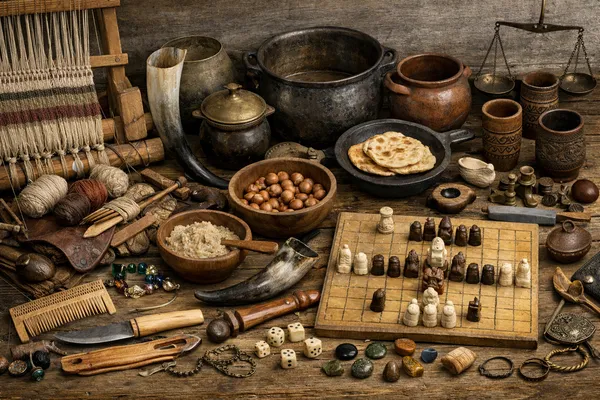 Not every Viking artifact relates to warfare. In fact, objects such as combs, keys, spindle whorls, loom weights, knives, cooking vessels, buckles, gaming pieces, bells, and personal ornaments reveal much about ordinary Norse life.
Additionally, microscopic and chemical studies of archaeological remains can identify food residues, plant remains, animal products, and craft materials. These findings help researchers reconstruct farming, textile production, food preparation, fishing, and household activities.
Viking Trade Networks and Long-Distance Travel
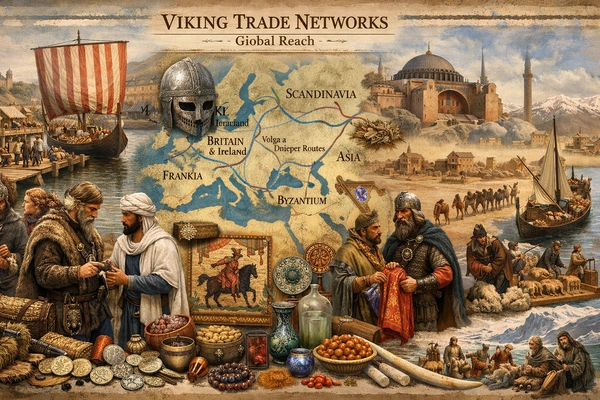 Scientific research shows that Viking communities participated in extensive trade networks. Goods moved along rivers, coastal routes, and overland trading systems that connected Scandinavia with Europe, the Baltic, the Islamic world, and parts of Asia.
Archaeologists have identified materials and goods including:
- Silver coins from the Islamic world
- Silk and luxury textiles from eastern trade networks
- Amber from the Baltic region
- Glass beads and metalwork from distant production centers
Moreover, ancient DNA and isotope studies of human remains show that Viking Age communities included people with varied geographic origins. Therefore, the archaeological record reflects considerable movement, migration, and cultural exchange.
Religious Viking Artifacts and Christian Influence
 Before widespread Christianization, many Norse communities practiced religious traditions involving gods such as Odin, Thor, Freyr, and Freyja. Archaeologists study amulets, ritual deposits, burial goods, figurines, and runestones to understand these belief systems.
- Thor’s hammer pendants and other amulets
- Ritual deposits in wetlands and other locations
- Grave goods associated with burial customs
- Runestones containing religious or memorial inscriptions
However, Christianity gradually spread through Scandinavia during the Viking Age. Consequently, crosses and other Christian symbols sometimes appear alongside traditional Norse imagery. These artifacts document a complex religious transition rather than a single sudden change.
Scientific Methods Used to Study Viking Artifacts
 Modern Viking archaeology combines traditional excavation with laboratory science. As a result, researchers can determine age, composition, manufacturing methods, geographic origin, and sometimes patterns of human movement.
Important scientific methods include:
- Radiocarbon dating for suitable organic materials
- Stable isotope analysis for studying diet and geographic mobility
- X-ray fluorescence (XRF) for identifying elemental composition
- Metallography for studying metalworking methods
- Ancient DNA analysis for researching ancestry and population movement
Therefore, scientific testing helps researchers separate archaeological evidence from folklore while building a more accurate picture of Viking Age society.
Collecting Viking Artifacts For Sale
Viking Artifacts For Sale can include small pieces of material culture such as jewelry, crosses, pendants, buckles, rings, bells, coins, arrowheads, tools, and other metal objects. However, identification should consider archaeological context, construction style, material, age, and provenance whenever available.
Because replicas and later objects can resemble ancient pieces, collectors should purchase Viking artifacts from knowledgeable sellers who clearly describe their material, cultural attribution, and available provenance. Responsible collecting also requires attention to cultural-property and antiquities laws.
Viking Artifacts For Sale | Authentic History You Can Hold
Viking artifacts provide important evidence for understanding a society that was technologically skilled, economically connected, highly mobile, and culturally complex. From weapons and ships to jewelry and household tools, each object can preserve evidence of craftsmanship, trade, belief, or everyday life.
At PrehistoricFossils.com, we have supplied authentic natural-history specimens and historical collectibles since 1997. We carefully describe our specimens so collectors can better understand what they are purchasing and the history represented by each piece.
Buy Viking Artifacts with Confidence — Your Trusted Source Since 1997. Authenticity Guaranteed.