
Fossil Coral For Sale | Genuine Rugose Coral Fossils
Fossil Coral For Sale | Genuine Rugose Coral Fossils
Fossil Coral For Sale offers collectors a fascinating look at ancient marine life. Rugose corals, also called horn corals, lived in prehistoric oceans from the Ordovician through the Permian Period, roughly 480 to 252 million years ago. These extinct marine animals formed beautiful calcium carbonate skeletons that often survived as fossils.
Today, rugose coral fossils provide valuable evidence of ancient marine ecosystems. Furthermore, their unusual shapes and detailed structures make them popular among fossil collectors, educators, and natural history enthusiasts.
What Are Rugose Coral Fossils?
Rugose corals belonged to an extinct group of marine animals known as Rugosa. Although they resembled modern corals, they represented a separate ancient group.
Many rugose corals grew as single animals with curved, horn-shaped skeletons. However, other species formed large colonies containing many individual coral animals.
Each coral animal, called a polyp, lived inside a protective mineral skeleton. In addition, its tentacles helped capture tiny organisms and food particles from seawater.
Ancient History of Horn Corals
Rugose corals first appeared during the Ordovician Period. Later, they became especially diverse during the Devonian Period, approximately 419 to 359 million years ago.
During this time, warm shallow seas covered large areas of North America. Consequently, marine environments supported abundant corals, brachiopods, crinoids, and other invertebrates.
However, rugose corals disappeared during the end-Permian mass extinction about 252 million years ago. Therefore, every genuine rugose coral fossil is older than the earliest known dinosaurs.
Types of Rugose Coral Fossils
Collectors can discover several interesting forms of ancient rugose corals.
- Solitary Horn Corals: Individual corals with curved or cone-shaped skeletons.
- Colonial Rugose Corals: Groups of coral animals that formed connected skeletal structures.
- Heliophyllum: A well-known Devonian horn coral with distinctive internal structures.
- Hexagonaria: A colonial rugose coral famous for forming Michigan’s Petoskey stones.
- Stereolasma: A genus of solitary rugose corals found in Paleozoic marine deposits.
How to Identify Genuine Fossil Coral
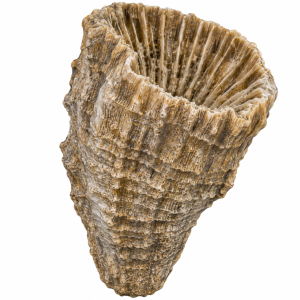
Rugose coral fossils often display distinctive external growth lines and internal skeletal patterns. For example, many solitary specimens feature a curved horn shape with a wider opening at one end.
Additionally, broken or polished surfaces may reveal thin radial partitions called septa. These structures supported the coral’s living tissue.
Some fossils preserve excellent natural detail. Others show mineral replacement, weathering, or partial preservation. Nevertheless, each specimen provides information about prehistoric marine environments.
Where Are Rugose Coral Fossils Found?
Rugose coral fossils occur in many parts of the world. In particular, Paleozoic limestone deposits throughout North America contain numerous examples.
Important fossil locations include Indiana, Kentucky, Ohio, Michigan, and New York. Furthermore, fossil-bearing rocks in Europe, Asia, and other regions preserve additional rugose coral species.
Because preservation varies, fossil specimens differ in size, color, shape, and surface detail.
Fossil Coral For Sale at Prehistoric Fossils
At Prehistoric Fossils, we appreciate the scientific history and natural beauty of genuine coral fossils. Whether you collect horn corals, colonial corals, or other prehistoric marine fossils, these ancient specimens make excellent additions to natural history collections.
Moreover, fossil corals offer educational value for students, teachers, and fossil enthusiasts.
Explore our Fossil Coral For Sale selection and discover genuine pieces of Earth’s prehistoric oceans.
Prehistoric Fossils – Your Trusted Source Since 1997.
100% Guaranteed Genuine Fossils.
Identification Label Included.
Do you have any questions? Contact Prehistoric Fossils. We are happy to help!
Showing 51–100 of 138 results
-

Calceola sandalina Rugose Coral 3
$10.00 -

Calceola sandalina Rugose Coral 31
$15.00 -

Calceola sandalina Rugose Coral 32
$20.00 -

Calceola sandalina Rugose Coral 4
$10.00 -

Calceola sandalina Rugose Coral 5
$10.00 -

Calceola sandalina Rugose Coral 6
$10.00 -

Calceola sandalina Rugose Coral 7
$10.00 -

Calceola sandalina Rugose Coral 8
$10.00 -

Calceola sandalina Rugose Coral 9
$10.00 -

Amplexiphyllum Horn Coral New York #27
$15.00 -

Amplexiphyllum Horn Coral New York #28
$15.00 -

Amplexiphyllum Horn Coral New York #29
$15.00 -

Amplexiphyllum Horn Coral New York #30
$15.00 -

Amplexiphyllum Horn Coral New York #31
$35.00 -

Amplexiphyllum Horn Coral New York #32
$45.00 -

New York Amplexiphyllum Horn Coral #26
$15.00 -

Actinocyathus Polished Rugose Fossilized Coral For Sale #10
$12.50 -

Actinocyathus Polished Rugose Fossilized Coral For Sale #11
$12.50 -

Actinocyathus Polished Rugose Fossilized Coral For Sale #13
$12.50 -

Actinocyathus Polished Rugose Fossilized Coral For Sale #14
$12.50 -

Actinocyathus Polished Rugose Fossilized Coral For Sale #16
$12.50 -

Actinocyathus Polished Rugose Fossilized Coral For Sale #17
$12.50 -

Actinocyathus Polished Rugose Fossilized Coral For Sale #18
$10.00 -

Actinocyathus Polished Rugose Fossilized Coral For Sale #19
$12.50 -

Actinocyathus Polished Rugose Fossilized Coral For Sale #20
$10.00 -

Actinocyathus Polished Rugose Fossilized Coral For Sale #22
$10.00 -

Actinocyathus Polished Rugose Fossilized Coral For Sale #23
$10.00 -

Actinocyathus Polished Rugose Fossilized Coral For Sale #24
$12.50 -

Actinocyathus Polished Rugose Fossilized Coral For Sale #26
$10.00 -

Actinocyathus Polished Rugose Fossilized Coral For Sale #27
$10.00 -

Actinocyathus Polished Rugose Fossilized Coral For Sale #28
$12.50 -

Actinocyathus Polished Rugose Fossilized Coral For Sale #29
$12.50 -

Actinocyathus Polished Rugose Fossilized Coral For Sale #31
$12.50 -

Actinocyathus Polished Rugose Fossilized Coral For Sale #32
$12.50 -

Actinocyathus Polished Rugose Fossilized Coral For Sale #33
$12.50 -

Actinocyathus Polished Rugose Fossilized Coral For Sale #34
$12.50 -

Actinocyathus Polished Rugose Fossilized Coral For Sale #35
$12.50 -

Actinocyathus Polished Rugose Fossilized Coral For Sale #36
$12.50 -

Actinocyathus Polished Rugose Fossilized Coral For Sale #37
$12.50 -

Actinocyathus Polished Rugose Fossilized Coral For Sale #38
$12.50 -

Actinocyathus Polished Rugose Fossilized Coral For Sale #39
$12.50 -

Actinocyathus Polished Rugose Fossilized Coral For Sale #40
$12.50 -

Actinocyathus Polished Rugose Fossilized Coral For Sale #41
$12.50 -

Actinocyathus Polished Rugose Fossilized Coral For Sale #42
$12.50 -

Actinocyathus Polished Rugose Fossilized Coral For Sale #44
$12.50 -

Actinocyathus Polished Rugose Fossilized Coral For Sale #45
$12.50 -

Actinocyathus Polished Rugose Fossilized Coral For Sale #46
$12.50 -

Actinocyathus Polished Rugose Fossilized Coral For Sale #47
$12.50 -

Actinocyathus Polished Rugose Fossilized Coral For Sale #48
$12.50 -

Actinocyathus Polished Rugose Fossilized Coral For Sale #49
$12.50
- Buy Fossils
- Fossils for Sale
- Large Selection
- Great Prices and Great Selection
- Authenticity Guaranteed
- Satisfaction Guaranteed
- Your TRUSTED SOURCE for over 25 years!
- Many more videos are available on our YouTube Channel.
Rugose Coral Fossils – Ancient Corals of the Paleozoic Seas
Fossil Coral For Sale
Rugose Coral fossils offer a fascinating look at marine life that existed hundreds of millions of years ago. Also known as horn corals, these ancient animals lived in shallow seas during the Paleozoic Era. Today, collectors value these fossils for their unique shapes, detailed structures, and rich geological history.
Furthermore, rugose corals help scientists understand ancient oceans, marine ecosystems, and changes in Earth’s environment.
What Is Rugose Coral?
Rugose coral belongs to the extinct coral order Rugosa. These ancient marine animals first appeared during the Ordovician Period, roughly 470 million years ago. However, they became especially common during the Silurian, Devonian, and Carboniferous periods.
Unlike modern stony corals, rugose corals had distinctive internal skeletal structures. Many species grew as single, horn-shaped animals. However, others formed colonies containing numerous individual polyps.
Each coral polyp lived inside a hard skeleton made mainly of calcium carbonate. As a result, many of these skeletons survived as fossils.
Why Are They Called Horn Corals?
Many rugose coral species developed curved, cone-shaped skeletons that resemble animal horns. Therefore, collectors commonly call them horn corals.
However, not all species had this shape. Some formed branching colonies, while others developed rounded or closely packed structures.
Inside each skeleton, thin vertical walls called septa helped support the coral polyp. In addition, some species developed horizontal partitions called tabulae.
These features help paleontologists identify different fossil species.
Where Are Rugose Coral Fossils Found?
Rugose coral fossils occur in Paleozoic sedimentary rocks worldwide. In particular, limestone and shale deposits often preserve excellent specimens.
Important fossil locations include:
-
United States: Indiana, Kentucky, Ohio, Michigan, and New York.
-
Canada: Ontario and other Paleozoic marine deposits.
-
Europe: England, Belgium, Germany, and Poland.
-
North Africa: Morocco and surrounding fossil-bearing regions.
For example, Devonian limestone deposits contain many well-preserved specimens. Additionally, some rugose coral fossils reveal beautiful internal structures when cut and polished.
How Did These Ancient Corals Live?
Rugose coral animals lived attached to the seafloor or resting on marine sediments. Like modern corals, they used tentacles to capture tiny organisms and food particles.
Most species inhabited marine environments. However, water depth and local conditions varied.
Furthermore, some colonial species helped build ancient reef communities. These habitats supported brachiopods, crinoids, trilobites, and other marine animals.
Consequently, rugose corals played an important role in Paleozoic ocean ecosystems.
When Did Rugose Corals Become Extinct?
Rugose coral disappeared during the Permian–Triassic mass extinction, approximately 252 million years ago.
This event eliminated many marine species. In fact, it represents the most severe known mass extinction in Earth’s history.
Although modern corals resemble certain ancient forms, today’s stony corals belong to a different evolutionary group.
Why Collect Rugose Coral Fossils?
Rugose coral fossils appeal to collectors because of their natural beauty, scientific value, and variety.
Moreover, their preserved growth patterns reveal details about prehistoric marine environments. Some specimens display intricate internal structures, while others retain their original horn-shaped appearance.
Whether displayed naturally or polished, genuine rugose coral fossils provide a lasting connection to Earth’s ancient oceans.