
Dinosaur Trackway Fossils For Sale | Genuine Dinosaur Footprints and Trace Fossils
Dinosaur Trackway Fossils For Sale: Footprints from the Prehistoric Past
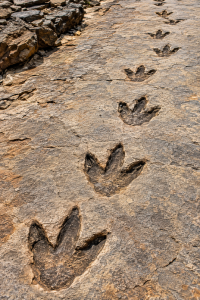
Dinosaur Trackway Fossils For Sale provide remarkable evidence of dinosaurs walking across ancient landscapes. A trackway consists of several footprints made as a dinosaur moved across soft ground. Unlike fossil bones and teeth, footprints are trace fossils. Therefore, they record an animal’s activity instead of preserving part of its body.
How Dinosaur Trackway Fossils Form
First, a dinosaur stepped into soft mud, sand, or volcanic ash. Soon afterward, fresh sediment covered the impressions. Over time, pressure and minerals hardened the footprint layer into rock. Later, erosion sometimes exposed the tracks at Earth’s surface. However, only a small number of dinosaur footprints survived this long process.
What Dinosaur Footprints Reveal
Dinosaur trackways can reveal details that skeletons cannot. For example, paleontologists measure each footprint’s length, width, depth, and position. They also study stride length and the space between individual tracks. As a result, researchers can estimate the dinosaur’s size, speed, direction, and walking style. Some rare tracks even preserve toe pads, claw marks, or skin impressions.
Identifying Dinosaur Trackway Fossils
However, scientists cannot always identify the exact dinosaur species that created a trackway. Several dinosaurs had feet with similar shapes. Consequently, paleontologists often give fossil tracks special scientific names called ichnotaxa. These names classify the footprints rather than the dinosaurs that produced them.
Collecting Dinosaur Trackway Fossils For Sale
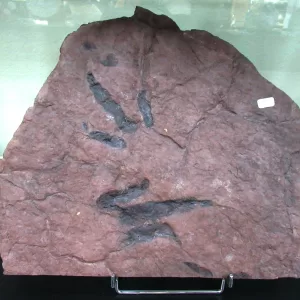
When considering Dinosaur Trackway Fossils For Sale, collectors should review each specimen’s age, locality, geological formation, condition, and restoration history. In addition, buyers should confirm that the fossil was collected and sold legally. Genuine specimens may include individual footprints, sections of trackways, or natural casts formed when sediment filled the original impressions.
Why Dinosaur Trackways Matter
Today, dinosaur trackway fossils help scientists reconstruct ancient habitats and animal behavior. Moreover, they provide dramatic evidence that living dinosaurs once crossed prehistoric landscapes. Each authentic trackway captures a brief event from millions of years ago and preserves that moment in stone.


Dinosaur Trackway Fossils For Sale: A Scientific Collector’s Guide
Dinosaur Trackway Fossils For Sale provide remarkable evidence of how dinosaurs moved and behaved millions of years ago. Unlike bones or teeth, footprints are trace fossils. Therefore, they record an animal’s activity rather than part of its body. A trackway may show whether a dinosaur walked, ran, turned, rested, or traveled beside other animals.
How Dinosaur Trackway Fossils Form
A dinosaur produced a footprint by stepping into soft mud, wet sand, or volcanic ash. Next, sediment filled the impression. Additional layers then buried the surface and protected it. Over time, pressure and minerals hardened the sediment into rock. Finally, natural erosion sometimes exposed the fossil track.
Collectors may encounter a true track or a natural cast. A true track preserves the original depression made by the dinosaur’s foot. In contrast, a natural cast formed when sediment filled that depression and hardened. Both forms can preserve useful evidence about the trackmaker and its environment.
What Dinosaur Tracks Reveal
Paleontologists measure stride length, track width, foot angle, and print depth. These details help researchers estimate speed, posture, direction, and approximate body size. Moreover, a series of parallel trackways may suggest that several dinosaurs moved through the same area. However, parallel tracks do not always prove social or herd behavior because the animals may have visited at different times.
Scientists also examine ripples, mud cracks, plant remains, and other features in the surrounding rock. As a result, track-bearing slabs may reveal important details about ancient shorelines, riverbanks, floodplains, and lake margins.
Identifying Genuine Dinosaur Footprints
Many meat-eating dinosaurs left narrow, three-toed tracks with pointed toe impressions. In contrast, many plant-eating dinosaurs made broader prints with shorter or more rounded toes. Sauropods often produced large, rounded hind-foot tracks and smaller front-foot impressions.
Nevertheless, track shape rarely identifies an exact dinosaur species. Instead, paleontologists commonly classify footprints with ichnotaxa, which are scientific names based on trace-fossil form. Furthermore, one dinosaur could leave different-looking tracks as it crossed wet, dry, soft, or firm ground.
Buying Dinosaur Trackway Fossils Responsibly
When considering Dinosaur Trackway Fossils For Sale, examine the specimen’s surface, rock type, locality, repairs, and collection history. Look for natural sediment patterns inside and around the print. Also, compare the track with documented examples from the same geological formation.
Artificially carved tracks may show fresh tool marks, unnatural grooves, or toes that look unusually sharp and perfect. Therefore, purchase fossils from an established dealer who provides accurate descriptions, locality information, and an identification label. Prehistoric Fossils has supplied genuine fossils and natural-history specimens since 1997, and authenticity is guaranteed.
Legal and Ethical Fossil Collecting
Fossil laws vary according to the country, state, landowner, and type of fossil. In the United States, collectors must obtain permission before removing fossils from private property. In addition, collecting vertebrate fossils from federal land generally requires a scientific research permit. Important track sites may also require permanent protection.
Consequently, responsible collectors should confirm that every specimen has a legal origin. Detailed records improve scientific value and help preserve important information for future owners, educators, and researchers.
Caring for Dinosaur Trackway Fossils
Protect trackway fossils from moisture, impact, and sudden temperature changes. Support heavy slabs from underneath, and never lift them by thin edges. Additionally, avoid harsh chemicals or household cleaners that could damage the rock.
Many scientifically important trackways remain in museums or protected field sites. Fortunately, accurate casts provide an ethical way to study rare examples. Whether choosing an original specimen or a detailed replica, responsibly sourced Dinosaur Trackway Fossils For Sale create a lasting connection to dinosaur behavior and paleontology.