
Polished Mineral Slabs For Sale | Natural Agate, Jasper & Stone
Polished Mineral Slabs For Sale
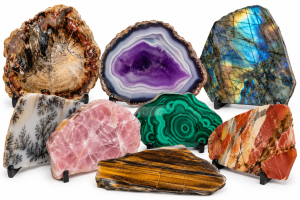
Polished Mineral Slabs For Sale offer collectors a clear view of the natural colors, patterns, and crystal structures hidden inside rocks and minerals. Lapidary artists create these slabs by cutting larger specimens into flat sections with diamond saws. Next, they grind and polish the surface. As a result, details that may be difficult to see on rough material become much easier to study and enjoy.
Many natural materials produce attractive polished slabs. For example, agate often displays colorful bands formed as silica-rich fluids deposited layers of microscopic quartz and chalcedony inside cavities. Jasper, meanwhile, may show red, yellow, brown, green, or cream colors caused by different minerals and impurities. In addition, petrified wood can produce striking slabs that preserve growth patterns and, in some cases, microscopic plant structures.
How Polished Mineral Slabs Are Made
First, a lapidary saw cuts the specimen to the desired thickness. Then, progressively finer abrasives remove saw marks and scratches. Finally, polishing compounds create a smooth and often reflective surface. However, different minerals require different polishing methods because hardness, grain structure, and composition can vary greatly.
Importantly, polishing does not create the natural designs inside the stone. Instead, it reveals features that formed through geological processes over thousands, millions, or even billions of years.
Natural Patterns and Geological Features
Collectors often choose polished mineral slabs because each piece shows a unique cross-section of the original specimen. Some slabs reveal mineral banding, crystal pockets, fossil structures, or contrasting mineral zones. Therefore, polished sections can have both decorative and educational value.
Choosing Polished Mineral Slabs For Sale
When comparing Polished Mineral Slabs For Sale, consider the natural pattern, mineral type, thickness, polish quality, size, and overall condition. At Prehistoric Fossils, we carefully describe our natural history specimens so customers can make informed collecting decisions. We have supplied genuine fossils, minerals, meteorites, and natural history items since 1997.
Because every natural specimen formed under different geological conditions, no two polished mineral slabs are exactly alike. Consequently, each slab offers a distinctive combination of natural science, geological history, and lapidary craftsmanship.
Showing 51–83 of 83 results
-

Polished Angelite Slab
$4.99 -

Polished Aragonite Slab
$4.99 -

Polished Black Tourmaline Slab
$4.99 -

Polished Bloodstone Slab
$4.99 -

Polished Blue Apatite Slab
$4.99 -

Polished Blue Calcite Slab
$4.99 -

Polished Dalmation Jasper Slab
$4.99 -

Polished Desert Jasper Slab
$4.99 -

Polished Epidosite Slab
$4.99 -

Polished Fire Quartz Slab
$4.99 -

Polished Green Opal Slab
$4.99 -

Polished Labradorite Slab
$4.99 -

Polished Lapis Lazuli Slab
$4.99 -

Polished Lepidolite Slab
$4.99 -

Polished Nephrite Jade Slab
$4.99 -

Polished Onyx Marble Slab
$4.99 -

Polished Orange Orthaclase with Tourmaline Slab
$4.99 -

Polished Red Jasper Slab
$4.99 -

Polished Rhodonite Slab
$4.99 -

Polished Rock Crystal Slab
$4.99 -

Polished Rose Quartz Slab
$4.99 -

Polished Sea Jasper Slab
$4.99 -

Polished Serpentine Slab from Peru
$4.99 -

Polished Snakeskin Rock Slab
$4.99 -

Polished Sodalite Slab
$4.99 -

Polished Stromatolite Slab
$4.99 -

Polished Sunstone Slab
$4.99 -

Polished Tiger’s Eye Slab
$4.99 -

Polished White Opal Slab
$4.99 -

Polished White Quartz Slab
$4.99 -

Polished Yellow Hematoid Quartz Crystal Slab
$4.99 -
Polished Ocean Jasper Slab
$4.99 -
Polished Serpentine Slab
$4.99
WHY SHOP WITH PREHISTORIC FOSSILS?
- Large Selection
- Great Prices and Great Selection
- Authenticity Guaranteed
- Satisfaction Guaranteed
- Your TRUSTED SOURCE for 25 years!
- Many more videos are available on our YouTube Channel
Polished Mineral Slabs For Sale
Polished Mineral Slabs For Sale offer collectors a beautiful way to study the natural colors, patterns, crystals, and textures found inside stone. Each slab begins as a natural rock or mineral specimen. After cutting, grinding, and polishing, the internal structure becomes much easier to see. As a result, polished slabs can be both decorative and scientifically interesting.
At PrehistoricFossils.com, we select mineral specimens for their natural beauty, geological interest, and display quality. Because every stone forms under different conditions, no two polished mineral slabs are exactly alike.
How Polished Mineral Slabs Are Made
First, a suitable rock or mineral specimen is cut with a lapidary saw. Most lapidary saws use diamond-edged blades because diamond can cut many hard minerals efficiently. Water or another coolant helps reduce heat and remove rock particles during the cutting process.
Next, the cut surface goes through several grinding stages. Coarse abrasives remove saw marks, while finer abrasives gradually smooth the surface. Finally, a polishing compound creates a glossy finish. However, the exact method depends on the hardness and structure of the material.
For example, quartz has a Mohs hardness of 7 and can accept a durable polish. Calcite, in contrast, has a hardness of about 3. Therefore, softer minerals require more careful handling to avoid scratches.
Natural Geological Patterns Revealed by Polishing
Importantly, polishing does not create the patterns inside a mineral slab. Instead, it reveals structures that already formed naturally within the stone.
For instance, agate often displays bands made of microscopic quartz crystals. These layers may form when silica-rich fluids deposit minerals inside cavities over long periods. Likewise, jasper can display swirls, streaks, and color zones caused by mineral impurities and changing geological conditions.
Petrified wood provides another excellent example. During fossilization, mineral-rich groundwater can deposit silica inside buried wood. Consequently, polished slabs may preserve growth rings, wood grain, and fine plant structures.
What Creates the Colors in Mineral Slabs?
Mineral color can come from several sources. In some minerals, color results directly from chemical composition. However, small amounts of trace elements can also create dramatic color changes.
For example, iron minerals often produce red, orange, yellow, or brown shades. Manganese can contribute pink, purple, or dark coloration. Meanwhile, copper-bearing minerals may produce blue or green colors.
In addition, microscopic inclusions and crystal structure can affect how light moves through or reflects from the stone. Because of these factors, two slabs from the same deposit may still look noticeably different.
Collecting and Displaying Natural Stone Slabs
Polished Mineral Slabs For Sale appeal to collectors for many reasons. Some buyers focus on color and pattern, while others collect specific minerals, geological formations, or locations. In addition, polished slabs work well as educational specimens because their flat surfaces make internal structures easy to examine.
Many collectors display slabs on stands, shelves, desks, or inside mineral cabinets. Larger pieces may also serve as natural decor. However, proper care is important. Some minerals scratch easily, while others can react with household acids. Therefore, gentle cleaning methods are usually best.
Why Every Mineral Slab Is Unique
Every polished slab represents a natural cross-section through a geological specimen. Its crystals, bands, veins, colors, and textures record processes that may have taken place over thousands or millions of years.
Therefore, polished mineral slabs are more than attractive decorative pieces. They provide a direct look at Earth’s geological history. Whether you collect minerals for science, display, education, or natural beauty, a polished slab offers a distinctive specimen shaped by both geology and skilled lapidary work.