
Mars Meteorites for Sale | From Outerspace
No Results Found
The page you requested could not be found. Try refining your search, or use the navigation above to locate the post.
- Buy Meteorites
- Meteorites for Sale
- Large Selection
- Great Prices and Great Selection
- Authenticity Guaranteed
- Satisfaction Guaranteed
- Your TRUSTED SOURCE SINCE 1997!
- Many more videos are available on our YouTube Channel.
Mars Meteorites on Earth: Scientific Evidence, Origins, and What They Reveal About the Red Planet
Introduction: Are There Really Rocks From Mars on Earth?
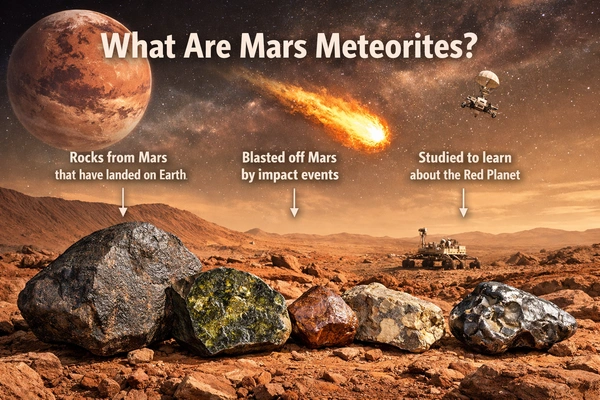
Yes—scientifically confirmed meteorites from Mars exist on Earth, and they provide some of the most valuable physical evidence we have for understanding the Red Planet without sending humans there.
More than 300 officially classified Martian meteorites have been identified worldwide. These rare space rocks were ejected from Mars by powerful asteroid impacts, traveled through space for millions of years, and eventually landed on Earth as meteorites.
This article explains how Mars meteorites reach Earth, how scientists identify them with certainty, and why they are critical to planetary science, astrobiology, and the study of early solar system history.
What Are Mars Meteorites?
Mars meteorites are fragments of Martian crust that were blasted off the planet’s surface by large asteroid impacts and later fell to Earth.
They are scientifically classified based on:
- Chemical composition
- Mineralogy
- Isotopic signatures
- Trapped Martian atmospheric gases
These meteorites are not speculative—their Martian origin is confirmed by laboratory analysis, including direct matches to atmospheric data collected by NASA’s Viking landers.
How Did Mars Meteorites Get to Earth?
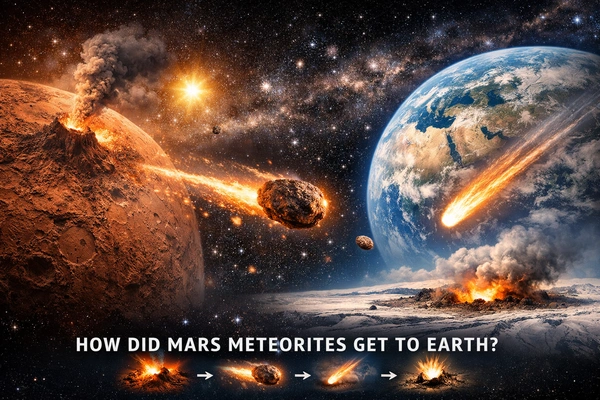
Step 1: Massive Impact on Mars
Large asteroids or comets strike Mars at extremely high velocities. Some impacts are powerful enough to eject surface material beyond Mars’ escape velocity (about 5 km/s).
Step 2: Ejection Without Melting
Contrary to popular belief, some rocks are ejected without being completely melted, preserving their original mineral structure.
Step 3: Interplanetary Travel
These fragments enter independent orbits around the Sun. Some travel through space for millions of years, exposed to cosmic radiation.
Step 4: Earth Impact
A small fraction of these rocks eventually intersect Earth’s orbit, pass through the atmosphere, and land as meteorites—often in deserts or Antarctica, where preservation is highest.
How Scientists Prove a Meteorite Came From Mars
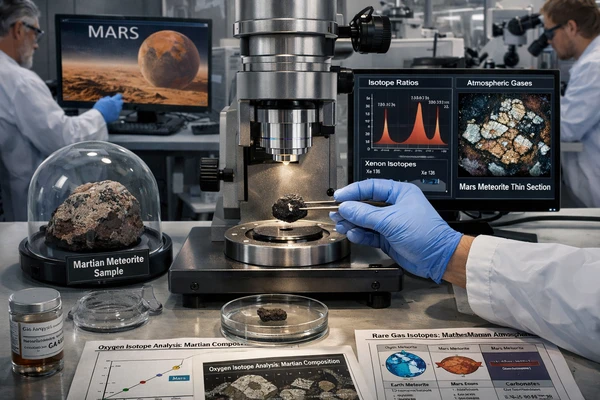
- Trapped Atmospheric Gases
Martian meteorites contain gas bubbles whose argon, nitrogen, and xenon isotopic ratios exactly match measurements taken by NASA’s Viking missions on Mars.
This is the gold standard of proof.
- Unique Oxygen Isotopes
Mars has a distinct oxygen isotope ratio (¹⁶O, ¹⁷O, ¹⁸O) that differs from Earth, the Moon, and asteroids.
- Young Volcanic Ages
Unlike most meteorites, many Martian meteorites are geologically young (as little as 180 million years old), consistent with Mars’ volcanic history.
Types of Martian Meteorites (SNC Group)
Martian meteorites are mainly divided into three primary classes:
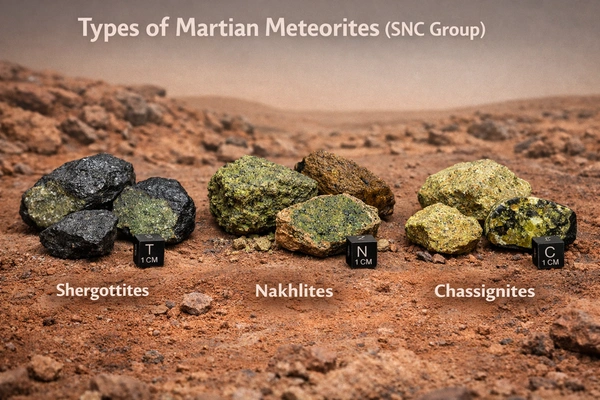
Shergottites
- Basaltic volcanic rocks
- Most common type
- Typically young (150–600 million years)
Nakhlites
- Formed from ancient lava flows
- Rich in clinopyroxene
- About 1.3 billion years old
Chassignites
- Rare, olivine-rich rocks
- Provide insight into Mars’ mantle
Together, these are known as SNC meteorites, named after the first discovered examples.
Where Are Mars Meteorites Found?
Most confirmed Martian meteorites have been recovered from:
- Antarctica – preserved in ice, easy to spot
- Sahara Desert – dry conditions prevent weathering
- Northwest Africa (NWA) – major source region
Famous examples include:
- ALH 84001 (Antarctica)
- Tissint Meteorite (Morocco, witnessed fall in 2011)
Do Mars Meteorites Contain Evidence of Life?
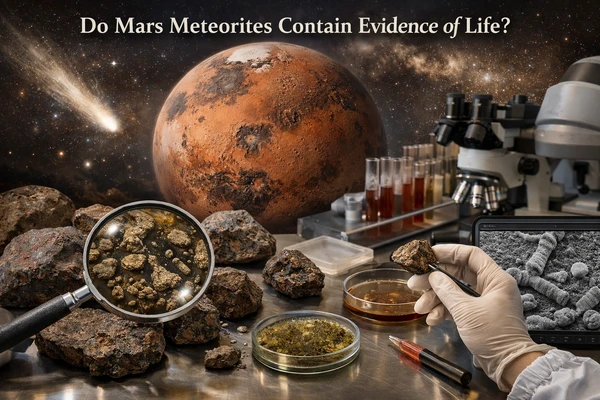
This is one of the most debated questions in planetary science.
ALH 84001 Controversy
In 1996, NASA scientists reported possible microfossil-like structures and organic compounds in ALH 84001.
While not definitive proof of life, the meteorite showed:
- Carbonate globules
- Magnetite crystals
- Complex organic molecules
Modern consensus: not proof of life, but strong evidence that Mars once had habitable conditions.
Why Mars Meteorites Are Scientifically Important
Mars meteorites allow scientists to:
- Study Mars without sample-return missions
- Analyze Martian water history
- Understand volcanic and atmospheric evolution
- Refine models of planetary formation
- Search for ancient biosignatures
They are the only physical samples of Mars currently available on Earth.
Conclusion: Mars Is Already Here
Mars meteorites provide a direct, tangible link between Earth and the Red Planet. These space rocks prove that planetary material naturally travels between worlds, reshaping how scientists think about solar system evolution—and even the possibility of life spreading between planets.
As exploration continues and future Mars sample-return missions are planned, Martian meteorites on Earth remain an irreplaceable scientific resource.