
Lunar Meteorites for Sale
Lunar Meteorites for Sale – A lunar meteorite is a meteorite that is known to have originated on the Moon. A meteorite hitting the Moon is normally classified as a transient lunar phenomenon. Most lunar meteorites are launched from the Moon by impacts making lunar craters of a few kilometers in diameter or less.
Lunar meteorites collected in Africa and Oman are, for all practical purposes, the only source of moon rocks available for private ownership. This is because all rocks collected during the Apollo moon-landing program are property of the United States government or of other nations to which the U.S. conveyed them as gifts. Similarly, all lunar meteorites collected by the U.S. and Japanese Antarctic programs are, by treaty, held by those governments for research and education purposes only. Check out our other Meteorites!
Showing all 17 results
-
Sold out!
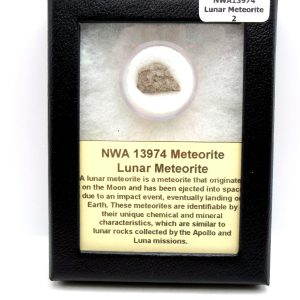
Lunar Meteorite NWA13974 Meteorites for Sale
$75.00 -
Sold out!
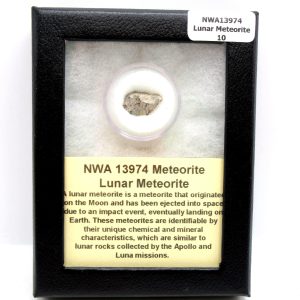
Lunar Meteorite NWA13974 Meteorites for Sale
$75.00 -
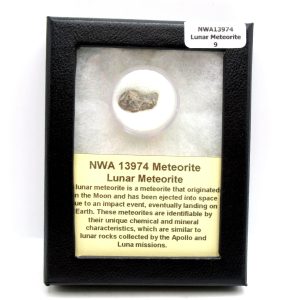
Lunar Meteorite NWA13974 Meteorites for Sale
$75.00 -
Sold out!
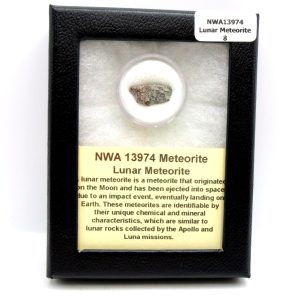
Lunar Meteorite NWA13974 Meteorites for Sale
$75.00 -
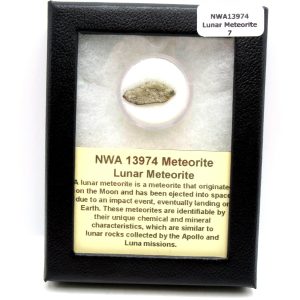
Lunar Meteorite NWA13974 Meteorites for Sale
$75.00 -
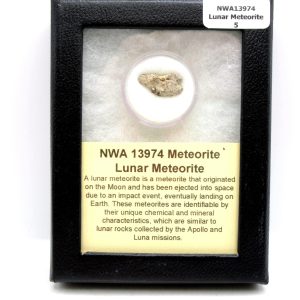
Lunar Meteorite NWA13974 Meteorites for Sale
$75.00 -
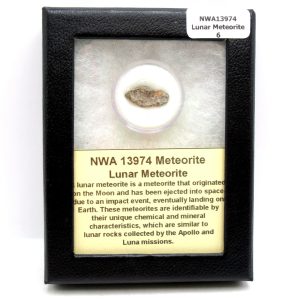
Lunar Meteorite NWA13974 Meteorites for Sale
$75.00 -
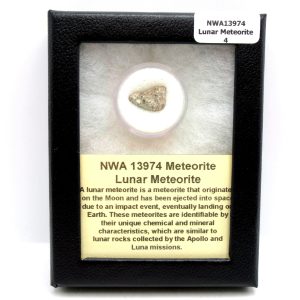
Lunar Meteorite NWA13974 Meteorites for Sale
$75.00 -
Sold out!
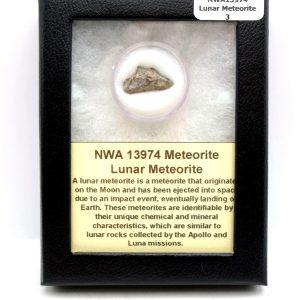
Lunar Meteorite NWA13974 Meteorites for Sale
$75.00 -
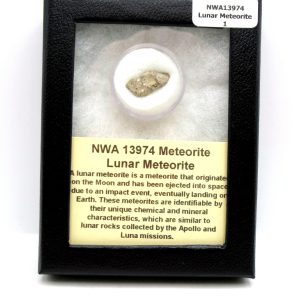
Lunar Meteorite NWA13974 Meteorites for Sale
$75.00 -
Sold out!

Moon Rock Lunar Meteorite Frame #2
$65.00 -
Sold out!

Moon Rock Lunar Meteorite Frame #3
$65.00 -

Moon Rock Lunar Meteorite Frame #4
$65.00 -
Sold out!

Moon Rock Lunar Meteorite Frame #5
$65.00 -
Sold out!

Moon Rock Lunar Meteorite Frame #7
$65.00 -
Sold out!

Moon Rock Lunar Meteorite Frame #8
$65.00 -

Moon Rock Lunar Meteorite Frame #9
$65.00
- Buy Meteorites
- Meteorites for Sale
- Large Selection
- Great Prices and Great Selection
- Authenticity Guaranteed
- Satisfaction Guaranteed
- Your TRUSTED SOURCE SINCE 1997!
- Many more videos are available on our YouTube Channel.
Lunar Meteorites on Earth: Scientific Evidence, Origins, and What They Reveal About the Moon
Lunar meteorites are rare extraterrestrial rocks originating from the Moon that have been discovered on Earth. Their existence provides direct physical evidence of lunar geology without the need for space missions. This article explains how lunar meteorites form, how they reach Earth, how scientists verify their origin, and why they are scientifically valuable
Introduction: What Are Lunar Meteorites?
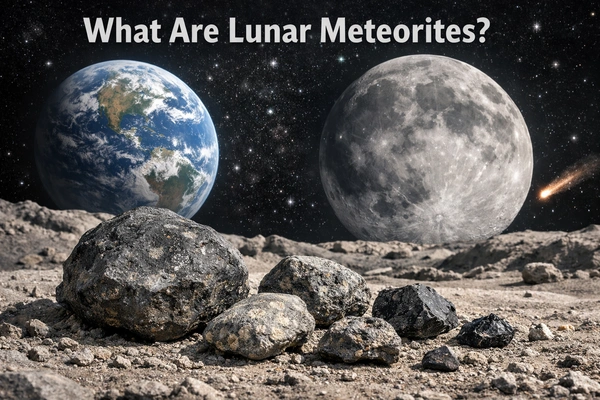
Lunar meteorites are fragments of the Moon that were ejected into space by asteroid or comet impacts and later fell to Earth as meteorites. Unlike Apollo lunar samples, which were deliberately collected by astronauts, lunar meteorites arrive naturally and are discovered in deserts, polar ice fields, and arid regions across the planet.
As of today, scientists have officially identified over 500 lunar meteorites, representing more than 80 distinct impact events on the Moon. These rocks provide invaluable insights into lunar history, surface processes, and planetary evolution.
How Do Lunar Meteorites Get to Earth?
- Impact Ejection from the Moon
The Moon lacks a thick atmosphere, so asteroid impacts strike its surface at full cosmic velocity. When a sufficiently large impact occurs:
- Rock is shock-fractured
- Some fragments reach escape velocity (~2.38 km/s)
- Debris is launched into heliocentric orbit
- Travel Through Space
Once ejected, lunar debris may orbit the Sun for thousands to millions of years. Gravitational interactions with Earth eventually pull some fragments into our planet’s atmosphere.
- Atmospheric Entry and Landing
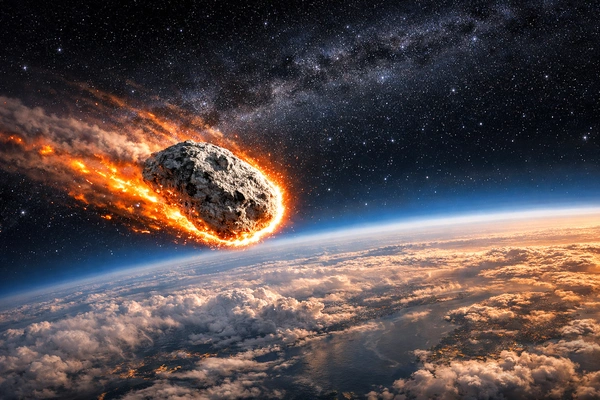
Upon entering Earth’s atmosphere, the rock becomes a meteor. Most burn up, but denser fragments survive and land as meteorites.
Where Are Lunar Meteorites Found on Earth?
Most lunar meteorites are discovered in environments where preservation and recognition are easier:
- Antarctica – Dark stones contrast with ice; minimal weathering
- North African deserts (e.g., Sahara) – Arid conditions preserve meteorites
- Oman deserts – One of the richest lunar meteorite sources
These locations are heavily surveyed by planetary scientists and meteorite hunters.
How Scientists Confirm a Meteorite Is Lunar
Identifying a lunar meteorite requires rigorous laboratory analysis. Scientists rely on multiple independent lines of evidence:
- Oxygen Isotope Ratios
Lunar meteorites have oxygen isotope signatures that match Apollo samples and differ from Earth and Mars.
- Mineralogy and Chemistry
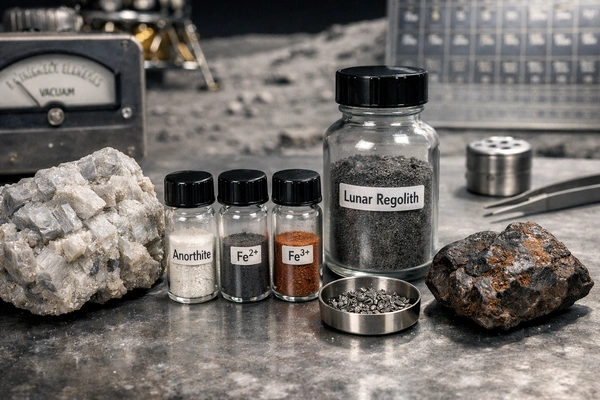
They contain lunar-specific minerals such as:
- Anorthite-rich plagioclase
- Low volatile content
- Distinctive iron oxidation states
- Shock Features
High-pressure impact features match known lunar cratering processes.
- Comparison with Apollo Samples
Geochemical fingerprints are cross-checked against samples returned by Apollo missions, confirming lunar origin beyond reasonable doubt.
Types of Lunar Meteorites
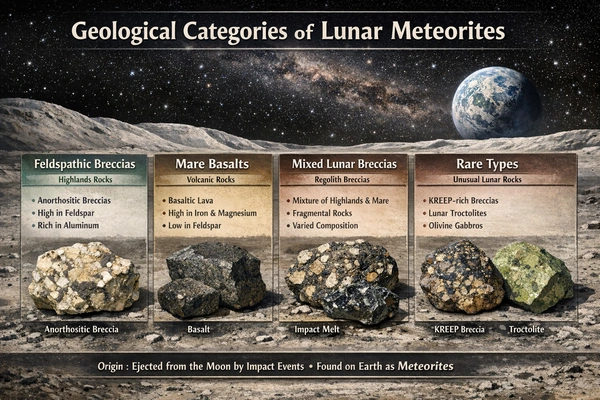
Lunar meteorites fall into several geological categories:
Lunar Highlands Meteorites
- Rich in anorthosite
- Represent ancient lunar crust
- Provide data on early Moon formation
Lunar Mare (Basaltic) Meteorites
- Formed from volcanic lava flows
- Dark, iron-rich basalts
- Reveal timing and composition of lunar volcanism
Brecciated Lunar Meteorites
- Composed of mixed fragments
- Cemented by impact processes
- Record billions of years of lunar surface history
Scientific Importance of Lunar Meteorites
Lunar meteorites are scientifically critical for several reasons:
- They expand sampling locations beyond Apollo landing sites
- They represent younger and older lunar material
- They help date lunar volcanic activity
- They refine models of Moon formation and differentiation
In many cases, lunar meteorites provide geological information unavailable from human missions alone.
Are Lunar Meteorites Rare?
Yes. Lunar meteorites represent less than 0.1% of all known meteorites. Their rarity is due to:
- The difficulty of escaping the Moon’s gravity
- Long transit times through space
- Earth’s atmosphere destroying most incoming material
Because of this rarity, lunar meteorites are highly valued by scientists, museums, and educational institutions.
Lunar Meteorites vs Apollo Moon Rocks
|
Feature |
Lunar Meteorites |
Apollo Samples |
|
Collection method |
Natural |
Human missions |
|
Location diversity |
Global Moon surface |
Limited landing sites |
|
Legal status |
Varies by country |
Government property |
|
Scientific value |
Extremely high |
Extremely high |
Both sources complement each other in lunar science.
Conclusion
Lunar meteorites are scientifically verified fragments of the Moon that provide a natural bridge between Earth and our closest celestial neighbor. Their journey—from violent lunar impacts to quiet desert discovery—offers a remarkable story grounded in physics, geology, and planetary science. As research advances, lunar meteorites continue to refine our understanding of the Moon’s origin, evolution, and role in the solar system.
Buy Meteorites from Prehistoric Fossils with Confidence. Your TRUSTED SOURCE since 1997. Authenticity Guaranteed.