
Gem and Mineral Jewelry for Sale | Natural Stone Jewelry
Gem and Mineral Jewelry For Sale
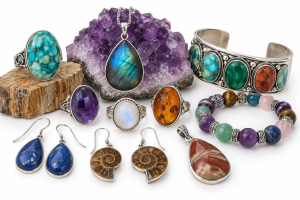
Gem and Mineral Jewelry For Sale combines natural geology with skilled craftsmanship. For thousands of years, people have shaped colorful minerals and gemstones into necklaces, rings, bracelets, earrings, and pendants. Today, collectors value natural mineral jewelry for its beauty, variety, and connection to Earth’s geological history.
What Is Gem and Mineral Jewelry?
Gem and mineral jewelry features naturally occurring materials chosen for their color, crystal structure, pattern, hardness, and durability. Quartz, amethyst, garnet, turquoise, and fluorite are familiar examples. In addition, lapidary artists often work with agate, jasper, amber, and petrified wood.
First, artisans select attractive natural material. Next, they cut and shape each specimen. Finally, polishing reveals colors, banding, inclusions, and crystal patterns that may have remained hidden inside the original stone.
How Minerals Used in Jewelry Form
Minerals form through several geological processes. For example, quartz crystals can grow from mineral-rich hydrothermal fluids. Meanwhile, other minerals crystallize as molten rock cools. Still others develop during metamorphism, when existing rocks experience heat and pressure.
As a result, pieces of Gem and Mineral Jewelry For Sale can display unique colors, inclusions, crystal patterns, or natural banding. Trace elements can also create striking colors. For instance, iron helps produce the purple color commonly seen in amethyst.
Collecting Gem and Mineral Jewelry For Sale
Natural gem and mineral jewelry offers more than decoration. It can also provide an interesting way to enjoy and study geology. However, mineral species vary greatly in hardness and durability. Therefore, softer stones require more careful handling than harder materials such as quartz.
Ultimately, Gem and Mineral Jewelry For Sale combines Earth’s natural geological processes with human craftsmanship. Consequently, every natural specimen can offer its own colors, textures, and mineral features, making each finished piece distinctive.
Showing 51–100 of 187 results
-
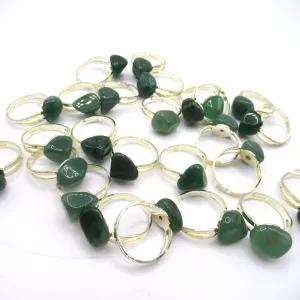
Aventurine Mineral Rings | Adjustable
$1.00 -
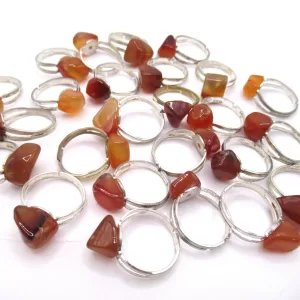
Carnelian Mineral Rings | Adjustable
$1.00 -

Emerald Pendant #10
$25.00 -

Emerald Pendant #9
$25.00 -

Fluorite Heart Pendant #1
$15.95 -

Fluorite Heart Pendant #10
$15.95 -

Fluorite Heart Pendant #11
$15.95 -

Fluorite Heart Pendant #2
$15.95 -

Fluorite Heart Pendant #3
$15.95 -

Fluorite Heart Pendant #4
$15.95 -

Fluorite Heart Pendant #5
$15.95 -

Fluorite Heart Pendant #6
$15.95 -

Fluorite Heart Pendant #7
$15.95 -

Fluorite Heart Pendant #8
$15.95 -

Fluorite Heart Pendant #9
$15.95 -
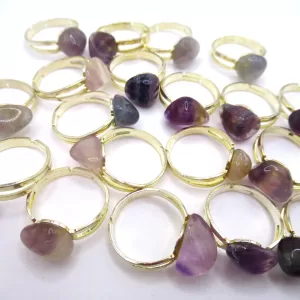
Fluorite Mineral Ring | Adjustable
$1.00 -

Genuine Mineral Ring #3
$5.00 -

Genuine Mineral Ring #4
$5.00 -

Genuine Mineral Ring #5
$5.00 -

Genuine Mineral Ring #6
$5.00 -

Genuine Mineral Ring #7
$5.00 -

Genuine Mineral Ring #8
$5.00 -

Geode Earrings #1
$25.00 -
Sold out!

Geode Earrings #3
$25.00 -

Geode Earrings #4
$25.00 -
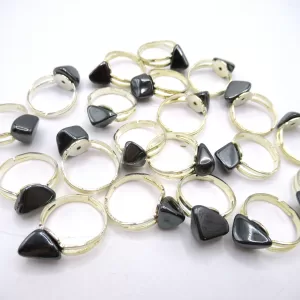
Hematite Mineral Rings | Adjustable
$1.00 -
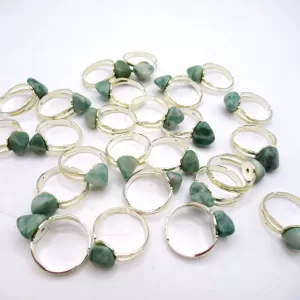
Jade Mineral Rings | Adjustable
$1.00 -
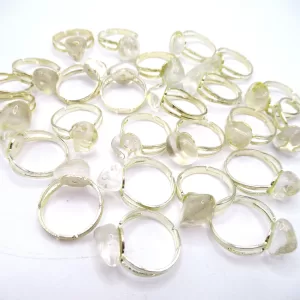
Quartz Crystal Mineral Rings | Adjustable
$1.00 -

Quartz Crystal Pendant Angel With Rose Quartz #1
$13.95 -

Quartz Crystal Pendant Angel With Rose Quartz #2
$13.95 -

Quartz Crystal Pendant Angel With Rose Quartz #4
$13.95 -

Quartz Crystal Pendant Angel With Rose Quartz #5
$13.95 -

Quartz Crystal Pendant Angel With Rose Quartz #6
$13.95 -
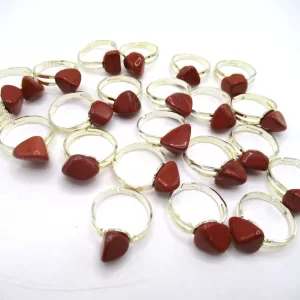
Red Jasper Mineral Rings | Adjustable
$1.00 -
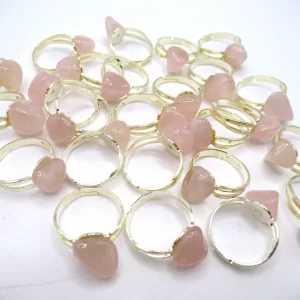
Rose Quartz Mineral Rings | Adjustable
$1.00 -
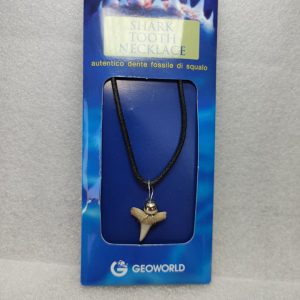
Shark Tooth Necklace #10
$8.00 -
Sold out!
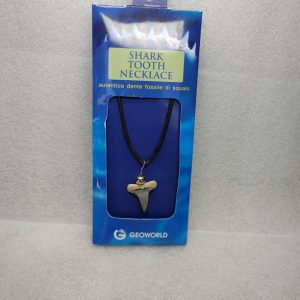
Shark Tooth Necklace #11
$8.00 -
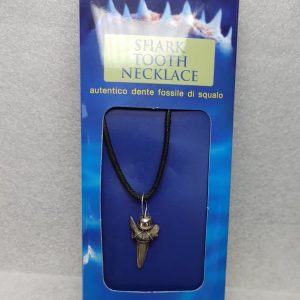
Shark Tooth Necklace #12
$8.00 -
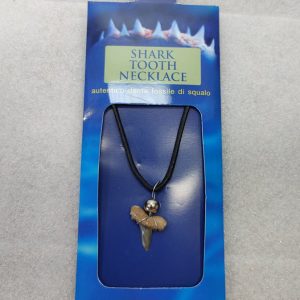
Shark Tooth Necklace #7
$8.00 -
Sold out!
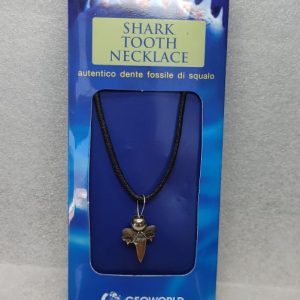
Shark Tooth Necklace #9
$8.00 -
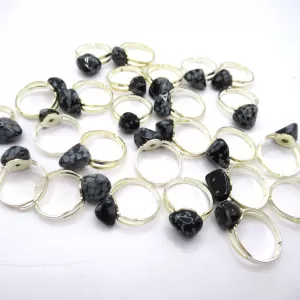
Snowflake Obsidian Mineral Ring | Adjust
$1.00 -

Topaz Pendant #2
$25.00 -

Topaz Pendant #3
$25.00 -

Topaz Pendant #4
$25.00 -

Topaz Pendant #5
$25.00 -

Topaz Pendant #6
$25.00 -

Topaz Pendant #7
$25.00 -

Topaz Pendant #8
$25.00 -

“Fancy Chip” Necklace
$15.00 -

7 Chakra Tree of Life Pendant
$9.99
WHY SHOP WITH PREHISTORIC FOSSILS?
- Large Selection
- Great Prices and Great Selection
- Authenticity Guaranteed
- Satisfaction Guaranteed
- Your TRUSTED SOURCE for 25 years!
- Many more videos are available on our YouTube Channel
Gem and Mineral Jewelry For Sale | Natural Stones Shaped by Geology
Gem and Mineral Jewelry For Sale combines the beauty of natural gemstones with skilled craftsmanship. For thousands of years, people have shaped minerals, rocks, fossils, and other natural materials into jewelry. Today, jewelry makers use quartz, agate, turquoise, garnet, amethyst, opal, jasper, and many other materials. Therefore, every natural stone can display colors, patterns, and crystal structures created by Earth’s geological processes.
What Are Gemstones?
A gemstone is a natural material valued for its beauty, durability, rarity, color, or unusual optical properties. Most gemstones are minerals. However, some popular gems come from other natural materials. For example, amber consists of fossilized tree resin, while pearls form inside certain mollusks.
Minerals have specific chemical compositions and crystal structures. Quartz, for example, consists mainly of silicon dioxide (SiO2). Amethyst is a purple variety of quartz. Its color develops because of trace iron, natural irradiation, and changes within the crystal structure.
Likewise, corundum consists mainly of aluminum oxide. Pure corundum has little color. However, trace elements create dramatic changes. Chromium produces the red color of ruby, while iron and titanium contribute to the blue color found in many sapphires.
Popular Minerals Used in Jewelry
Gem and Mineral Jewelry For Sale may feature minerals with many different levels of hardness and durability. Quartz ranks 7 on the Mohs hardness scale. Therefore, amethyst, citrine, rock crystal, and other quartz varieties can withstand normal jewelry use.
However, some attractive minerals require more care. Calcite ranks only 3 on the Mohs hardness scale. Consequently, it scratches more easily than quartz. Fluorite ranks about 4 and also has perfect cleavage. This means it can split along specific planes in its crystal structure. For this reason, softer minerals often work better in pendants or earrings than in rings worn every day.
Meanwhile, agate and jasper make excellent jewelry stones. Both consist largely of microcrystalline quartz. In addition, they occur in a wide range of colors and patterns. Lapidary artists commonly shape these stones into smooth, polished cabochons.
How Gem and Mineral Jewelry Is Made
First, a lapidary artist examines the rough stone for color, patterns, fractures, and crystal structure. Next, the artist cuts the material with specialized diamond tools. Afterward, grinding wheels gradually shape the stone.
Then, progressively finer abrasives smooth its surface. Finally, polishing creates the desired luster. Depending on the mineral, the finished gemstone may become a cabochon, bead, carving, polished crystal, or faceted stone.
Faceting works especially well with transparent gems. Carefully positioned flat surfaces, called facets, control how light travels through the gemstone. Therefore, skilled cutting can improve brilliance, color, and visual appeal.
Natural Gemstone Colors and Inclusions
Natural gemstones often contain inclusions. These may include tiny crystals, mineral grains, fractures, liquids, or gas bubbles trapped during formation. Although some inclusions reduce clarity, others increase scientific interest and help create distinctive optical effects.
For example, aligned rutile needles can produce a star-shaped optical effect called asterism. Similarly, parallel microscopic structures may produce chatoyancy, commonly known as the “cat’s-eye” effect.
Furthermore, gemstone colors can reveal information about mineral chemistry and geological history. Trace elements, structural defects, and natural radiation may all influence color.
Wear a Piece of Earth’s Geological History
Gem and Mineral Jewelry For Sale offers more than attractive decoration. Each natural stone preserves evidence of Earth’s geological history. Heat, pressure, volcanic activity, mineral-rich fluids, sedimentation, and other natural processes can all contribute to the formation of gemstones and minerals.
Therefore, a finished piece of gem and mineral jewelry combines natural history with skilled craftsmanship. Whether you prefer colorful agate, sparkling quartz, deep-purple amethyst, polished jasper, or another natural mineral, gemstone jewelry provides a beautiful way to appreciate geology while wearing a unique piece of the natural world.