
Fossil Sponges for Sale
Fossil Sponges for Sale. Sponges are filter-feeders that spend their lives attached to the lake or sea floor and are the oldest known members of the animal kingdom.
The earliest sponge fossils date to the Cambrian Period, about 535 million years ago. They consist of spicules, little rods of quartz or calcite that make up the skeletons of many
present-day sponges.
We offer a selection of fossil sponges for sale from the Devonian to Jurassic Periods.
Showing all 13 results
-

Plumalina plumaria #1
$55.00 -
Sold out!

Plumalina plumaria #2
$55.00 -

Plumalina plumaria #4
$55.00 -

Plumalina plumaria #6
$95.00 -
Sold out!
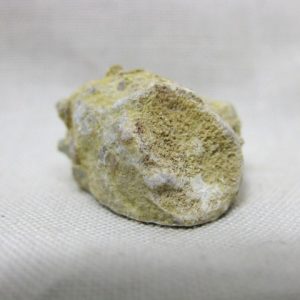
Solenopora compacta Sponge #1
$10.00 -
Sold out!
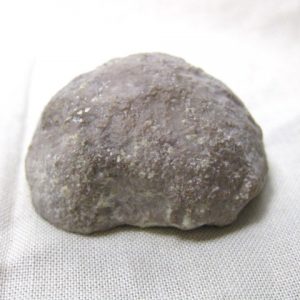
Solenopora compacta Sponge #11
$17.50 -
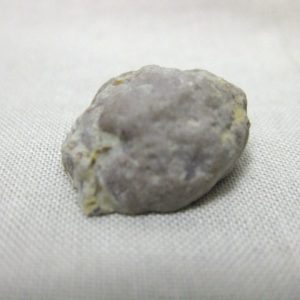
Solenopora compacta Sponge #3
$10.00 -
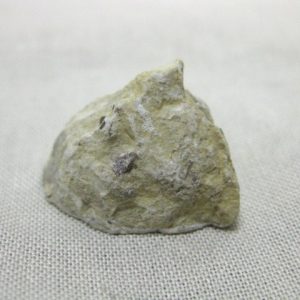
Solenopora compacta Sponge #4
$10.00 -
Sold out!
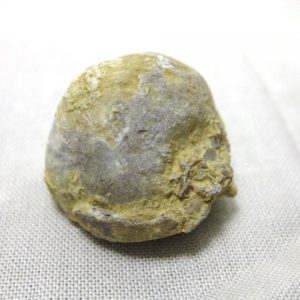
Solenopora compacta Sponge #5
$10.00 -
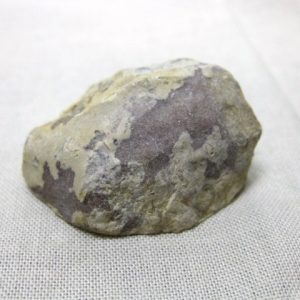
Solenopora compacta Sponge #6
$15.00 -
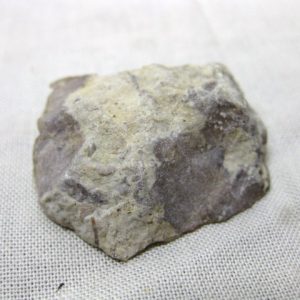
Solenopora compacta Sponge #7
$15.00 -
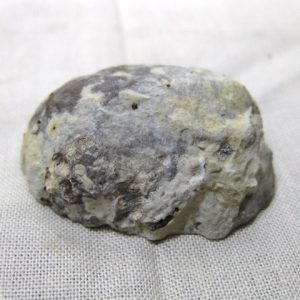
Solenopora compacta Sponge #8
$17.50 -
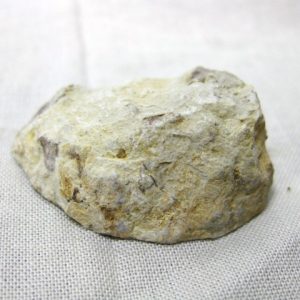
Solenopora compacta Sponge #9
$17.50
- Buy Fossils
- Fossils for Sale
- Large Selection
- Great Prices and Great Selection
- Authenticity Guaranteed
- Satisfaction Guaranteed
- Your TRUSTED SOURCE SINCE 1997!
- Many more videos are available on our YouTube Channel.
Fossil Sponges: Ancient Architects of Earth’s Earliest Ecosystems
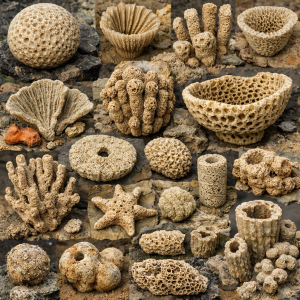
Fossil sponges represent some of the earliest known multicellular life forms on Earth, with a fossil record extending back over 600 million years. These organisms played a foundational role in early marine ecosystems, reef construction, and biogeochemical cycling.
- Introduction to Fossil Sponges (Porifera)
Sponges belong to the phylum Porifera, a basal group of multicellular animals characterized by porous bodies, lack of true tissues, and a filter-feeding lifestyle. Fossil sponges are critically important to paleontology because they document:
- The rise of early animal life
- The development of reef ecosystems
- Early biomineralization processes
The fossil record of sponges predates most other metazoans, making them essential for understanding Precambrian and early Paleozoic life.
SEO keywords: fossil sponges, Porifera fossils, ancient sponges, early marine life
- Evolutionary History and Geological Range
2.1 Precambrian Origins
The earliest sponge fossils date to the Ediacaran Period (ca. 635–541 Ma). While body fossils are rare, biomarker evidence (e.g., sponge-specific steranes) strongly supports the presence of demosponges before the Cambrian Explosion.
2.2 Cambrian Radiation
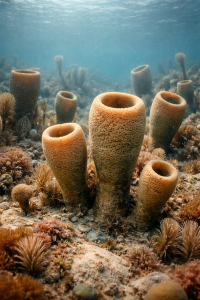
During the Cambrian Period, sponges diversified dramatically, coinciding with:
- Increased seawater calcium availability
- Expansion of shallow marine habitats
- Emergence of reef ecosystems
2.3 Paleozoic to Mesozoic Persistence
Sponges survived multiple mass extinctions, including:
- End-Ordovician extinction
- Late Devonian reef collapse
- Permian–Triassic extinction
Their resilience highlights adaptive flexibility in skeletal composition and ecological niches.
- Taxonomy of Fossil Sponges
Fossil sponges are classified into several major classes based on skeletal composition:
3.1 Demospongiae
- Skeleton composed of siliceous spicules and/or spongin
- Most abundant in both fossil and modern records
- Often preserved as silica replacements or molds
3.2 Hexactinellida (Glass Sponges)
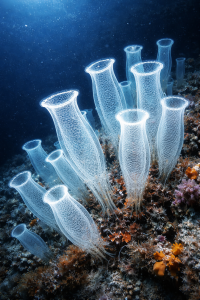
- Characterized by six-rayed siliceous spicules
- Common in deep-marine Paleozoic and Mesozoic deposits
- Exceptionally preserved in fine-grained sediments
3.3 Calcarea
- Skeletons composed of calcium carbonate spicules
- Less commonly fossilized due to dissolution
- Important in shallow marine environments
3.4 Archaeocyatha (Extinct Group)
- Reef-building sponges of the Early Cambrian
- Among the first metazoans to construct reefs
- Extinct by the Middle Cambrian
- Modes of Fossil Preservation
Fossil sponges are preserved through multiple taphonomic pathways:
4.1 Silicification
Replacement of organic tissue with silica, producing detailed three-dimensional fossils.
4.2 Carbonate Replacement
Common in calcareous sponges and reef settings.
4.3 Molds and Casts
External or internal impressions preserved in sedimentary rock.
4.4 Lagerstätten Preservation
Exceptional sites (e.g., Burgess Shale–type deposits) preserve delicate sponge anatomy.
- Paleoecological Importance of Fossil Sponges
Fossil sponges were key ecosystem engineers:
- Stabilized sediments
- Filtered vast volumes of seawater
- Provided habitats for early invertebrates
5.1 Reef Construction
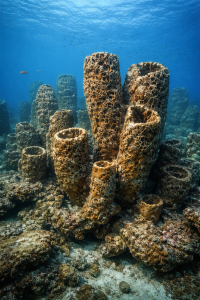
Sponges were among the earliest reef builders, preceding corals by tens of millions of years.
5.2 Nutrient Cycling
Their filtration systems influenced:
- Carbon cycling
- Silica deposition
- Microbial community structure
- Scientific and Educational Significance
6.1 Evolutionary Biology
Sponges inform research on:
- Origins of multicellularity
- Early animal developmental pathways
- Molecular clock calibration
6.2 Stratigraphy and Biostratigraphy
Certain sponge taxa serve as index fossils for Paleozoic marine strata.
6.3 Modern Climate Analogues
Studying ancient sponge reefs helps scientists model:
- Ocean acidification responses
- Reef collapse and recovery dynamics
- Conclusion
Fossil sponges represent a cornerstone of Earth’s biological and geological history. Their extraordinary longevity, structural diversity, and ecological importance make them invaluable to paleontological research and public education. As new analytical techniques—such as micro-CT scanning and geochemical profiling—continue to emerge, fossil sponges will remain central to understanding the earliest chapters of animal life on Earth.
Buy Fossils with Confidence. Authenticity Guaranteed