
Atomic Bomb Artifacts For Sale | Manhattan Project & WWII
Atomic Bomb Artifacts For Sale: Historical Objects From the Nuclear Age
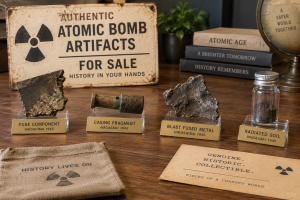
Atomic Bomb Artifacts For Sale can include authentic historical objects connected with the Manhattan Project, the Trinity nuclear test, Hiroshima, Nagasaki, and the beginning of the atomic age. These artifacts preserve physical evidence from one of the most important periods in modern scientific and military history. Therefore, well-documented examples can help collectors, historians, and researchers better understand the people, places, and technology involved.
Manhattan Project Atomic Bomb Artifacts For Sale
The United States organized the Manhattan Project during World War II to develop the first atomic bombs. Scientists, engineers, military personnel, and workers operated at major sites such as Los Alamos, Oak Ridge, and Hanford. Then, on July 16, 1945, researchers conducted the Trinity Test in New Mexico. This test marked the world’s first successful nuclear weapon detonation.
As a result, Atomic Bomb Artifacts For Sale may include period documents, photographs, identification badges, tools, equipment, correspondence, newspapers, and personal objects associated with Manhattan Project workers. However, provenance remains important because reproductions and incorrectly identified items also exist.
Hiroshima and Nagasaki Historical Artifacts
On August 6, 1945, an atomic bomb exploded over Hiroshima, Japan. Three days later, another atomic bomb struck Nagasaki. Consequently, surviving objects from these cities became important historical evidence of the bombings and their effects.
For example, museums preserve damaged watches, bottles, ceramics, clothing, coins, building materials, and personal belongings from affected areas. In addition, scientists and historians study these objects alongside photographs, written records, and archaeological evidence.
Authenticity and Provenance of Atomic Bomb Artifacts
Above all, collectors considering Atomic Bomb Artifacts For Sale should look for clear identification and reliable provenance whenever possible. Documentation may include collection history, military records, photographs, labels, or other supporting evidence.
When properly identified and responsibly preserved, atomic bomb artifacts provide direct connections to the scientific, military, and human history of the nuclear age. Therefore, these objects can serve as meaningful historical collectibles as well as educational tools for future generations.
Showing all 13 resultsSorted by latest
-
Sold out!
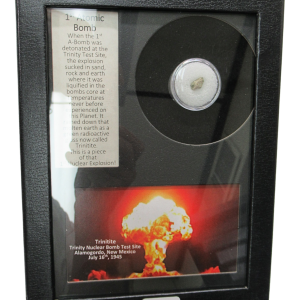
Trinity Atomic Glass For Sale | Genuine Atomic Bomb Glass #100
$45.00 -
Trinity Atomic Glass For Sale | Genuine Atomic Bomb Glass #101
$45.00 -
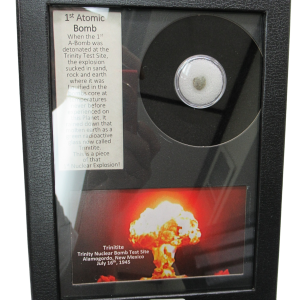
Trinity Atomic Glass For Sale | Genuine Atomic Bomb Glass #99
$45.00 -
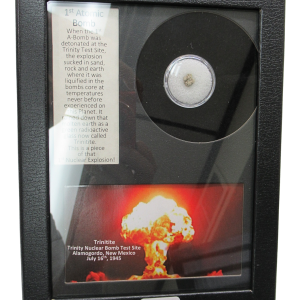
Trinity Atomic Glass For Sale | Genuine Atomic Bomb Glass #98
$45.00 -
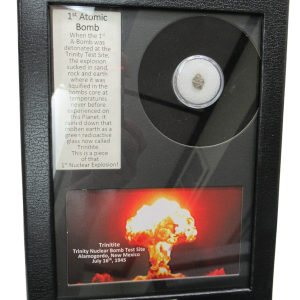
Trinity Atomic Glass For Sale | Genuine Atomic Bomb Glass #97
$45.00 -
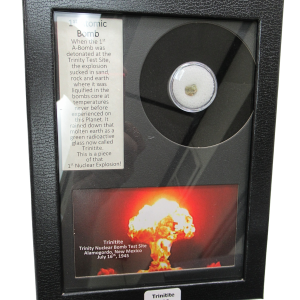
Trinity Atomic Glass For Sale | Genuine Atomic Bomb Glass #96
$45.00 -
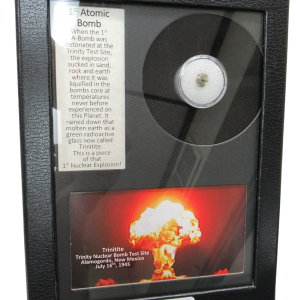
Trinity Atomic Glass For Sale | Genuine Atomic Bomb Glass #95
$45.00 -
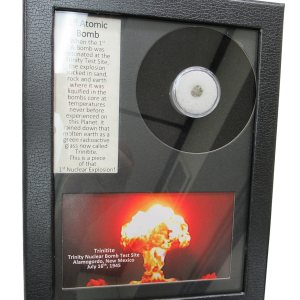
Trinity Atomic Glass For Sale | Genuine Atomic Bomb Glass #94
$45.00 -
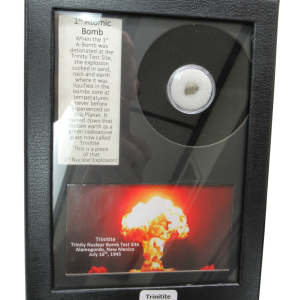
Trinity Atomic Glass For Sale | Genuine Atomic Bomb Glass #93
$45.00 -
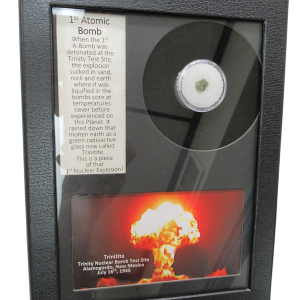
Trinity Atomic Glass For Sale | Genuine Atomic Bomb Glass #92
$45.00 -
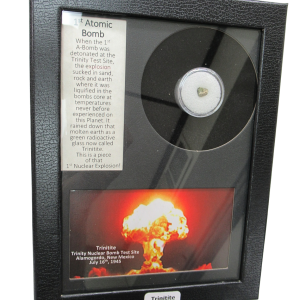
Trinity Atomic Glass For Sale | Genuine Atomic Bomb Glass #91
$45.00 -
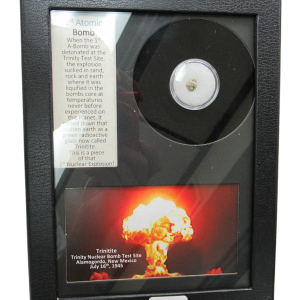
Trinity Atomic Glass For Sale | Genuine Atomic Bomb Glass #90
$45.00 -
Sold out!
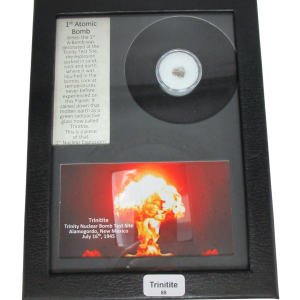
Trinitite Atomic Bomb Glass Frame from New Mexico #88
$45.00
- Buy Artifacts
- Artifacts for Sale
- Large Selection
- Great Prices and Great Selection
- Authenticity Guaranteed
- Satisfaction Guaranteed
- Your TRUSTED SOURCE for over 25 years!
- Many more videos are available on our YouTube Channel.
Atomic Bomb Artifacts For Sale | Trinitite and Trinity Test History
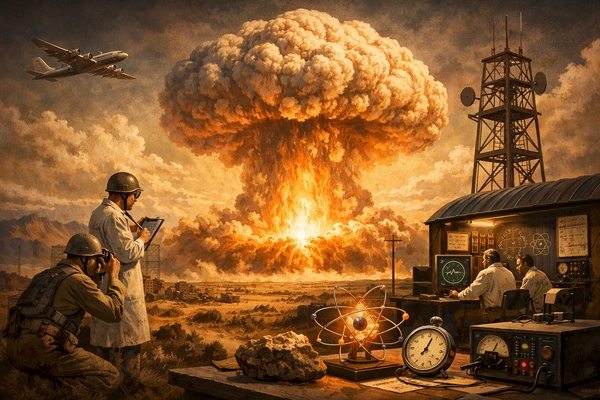 Atomic Bomb Artifacts For Sale can provide a tangible connection to one of the most important turning points in modern history. Among the best-known atomic-era artifacts is Trinitite, the green, glass-like material formed during the Trinity nuclear test on July 16, 1945. Because the Trinity test was the first detonation of a nuclear device, authentic Trinitite holds scientific, educational, and historical importance.
Today, researchers, museums, historians, educators, and collectors study surviving atomic bomb artifacts to better understand nuclear science, the Manhattan Project, and the beginning of the Atomic Age. At Prehistoric Fossils, we focus on genuine historical specimens with clear identification whenever possible.
Atomic Bomb Artifacts For Sale and the Trinity Test
The Trinity nuclear test took place in the Jornada del Muerto region of New Mexico as part of the Manhattan Project. The test used a plutonium implosion device commonly called “The Gadget.” When it detonated, the intense heat melted and transformed surface materials around the test area.
Key Facts About the Trinity Nuclear Test
- Date: July 16, 1945
- Location: Jornada del Muerto, New Mexico
- Program: Manhattan Project
- Device: “The Gadget”
- Type: Plutonium implosion device
- Yield: Approximately 20 kilotons of TNT equivalent
As a result, the blast permanently altered the immediate test area. In addition, it produced one of the most recognizable types of atomic bomb artifacts: Trinitite.
What Is Trinitite?
Trinitite, sometimes called atomic glass or Alamogordo glass, is a glass-rich material created when the Trinity explosion melted and fused desert sediment. The extreme heat transformed quartz, feldspar, and other minerals within seconds.
Additionally, some Trinitite contains microscopic traces of materials associated with the test structure and device. Therefore, each specimen can preserve evidence of both the desert environment and the nuclear event that created it.
Common Characteristics of Trinitite
- Pale green, gray-green, or olive coloration
- Glassy or partly glassy texture
- Small bubbles and irregular surfaces
- Fused quartz and feldspar
- Occasional metallic inclusions
- Low but measurable residual radioactivity in some specimens
How Atomic Bomb Artifacts Such as Trinitite Formed
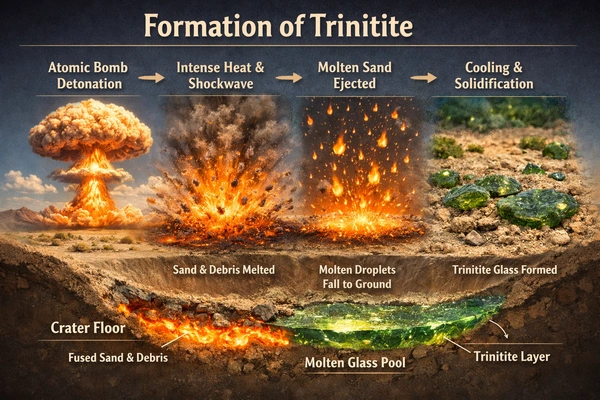 Trinitite formed extremely quickly during the Trinity test. First, the tremendous heat melted surface sand and other materials near the detonation area. Next, molten material mixed with vaporized and fragmented debris. Finally, the material cooled and solidified into irregular pieces of glass-rich rock.
Three Main Stages of Trinitite Formation
- Extreme Heating: The explosion heated and melted surface sediment.
- Material Mixing: Molten sand combined with small amounts of other debris.
- Rapid Cooling: The fused material cooled and hardened into Trinitite.
Unlike natural volcanic glass such as obsidian, Trinitite formed through a human-created nuclear explosion. For that reason, it represents a highly unusual form of anthropogenic glass.
Scientific Importance of Atomic Bomb Artifacts
Atomic Bomb Artifacts For Sale may appeal to collectors, but authentic examples also have genuine scientific value. Researchers have examined Trinitite to study nuclear fallout, isotope distribution, high-temperature mineral changes, and the physical effects of nuclear detonations.
Scientific Uses of Trinitite
- Studying fallout chemistry
- Examining isotope distribution
- Analyzing extreme-temperature glass formation
- Investigating nuclear forensic methods
- Teaching radiation detection and nuclear science
Because Trinitite formed during a known historical event, scientists can compare its chemistry and structure with documented conditions from the Trinity test.
Educational Value of Atomic Bomb Artifacts
Authentic atomic-era artifacts can help students connect physical objects with major events in science and history. For example, Trinitite can support lessons about nuclear physics, World War II, the Manhattan Project, radiation, and the development of nuclear technology.
Educational Uses
- Demonstrating the effects of extreme heat
- Supporting lessons about the Manhattan Project
- Teaching the history of nuclear science
- Introducing radiation measurement
- Providing material for museum and classroom displays
Is Trinitite Radioactive?
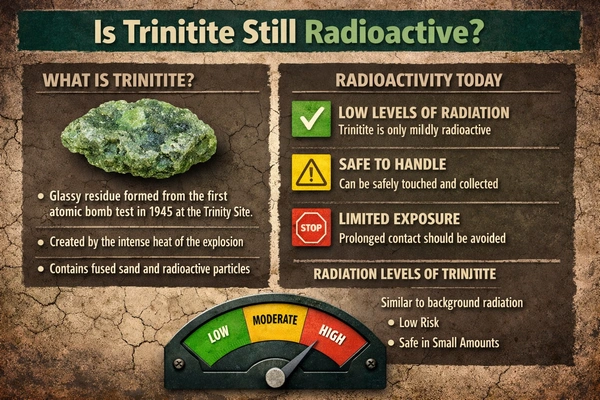 Yes, authentic Trinitite can retain low levels of residual radioactivity. Some specimens contain measurable radioactive isotopes left from the Trinity test. However, radiation levels vary from specimen to specimen.
For this reason, collectors should store and handle historical radioactive materials responsibly. In addition, owners should follow any applicable local, state, federal, shipping, or display regulations.
Is Trinitite Legal to Own?
Historical Trinitite that entered private collections before removal from the Trinity Site was prohibited can still exist in the collector market. However, the Trinity Site itself is protected, and visitors may not remove Trinitite or other materials from the site.
Therefore, provenance is important when purchasing Atomic Bomb Artifacts For Sale. Buyers should look for reputable sellers who clearly identify specimens and avoid material represented as recently collected from protected areas.
Trinitite as a Historical Atomic Bomb Artifact
Trinitite is more than unusual glass. It is a physical artifact connected directly to the first nuclear test in human history. As a result, it represents the beginning of the Atomic Age and a major transformation in science, warfare, diplomacy, and global politics.
What Trinitite Represents
- The first nuclear weapons test
- The Manhattan Project
- The beginning of the Atomic Age
- Advances in nuclear physics
- The growing debate over nuclear weapons and responsibility
For historians, educators, and collectors, Trinitite preserves a direct material link to a moment that changed the modern world.
Trinitite Compared With Other Atomic Glasses
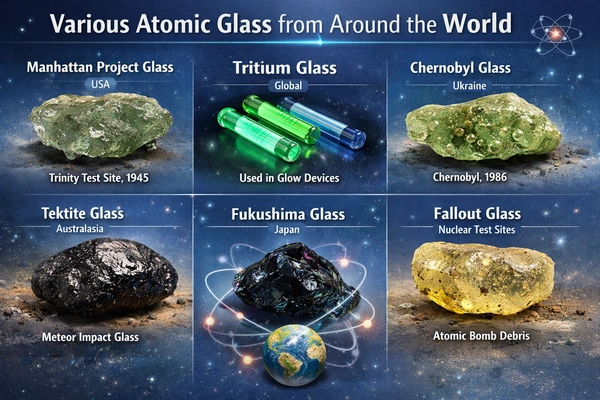
Other nuclear tests produced glass-like materials under extreme heat. However, Trinitite remains especially significant because it formed during the first nuclear explosion in history. Its documented connection to the Trinity test gives it exceptional historical context.
Collecting Atomic Bomb Artifacts For Sale
Collectors should focus on authenticity, documentation, condition, and provenance when evaluating Atomic Bomb Artifacts For Sale. Because historically significant material can be misidentified, reliable labeling and seller experience matter.
Additionally, collectors should distinguish authentic Trinitite from ordinary slag, melted glass, and unrelated industrial material. Genuine specimens should have a credible history and physical characteristics consistent with known Trinity Site material.
What to Look for When Buying Atomic Bomb Artifacts
- Clear specimen identification
- Documented or reasonable provenance
- Accurate historical description
- Responsible storage guidance
- A reputable and experienced seller
Why Buy Atomic Bomb Artifacts From Prehistoric Fossils?
Prehistoric Fossils has supplied fossils, meteorites, minerals, and historical collectibles since 1997. We understand that provenance and accurate identification are especially important when purchasing unusual historical specimens.
Therefore, when available, our Atomic Bomb Artifacts For Sale are presented with identification information designed to help collectors better understand what they are purchasing. We also focus on educational value, historical context, and responsible collecting.
Atomic Bomb Artifacts For Sale | Authentic Trinitite
Trinitite and the Trinity Test mark one of the most important turning points in modern history. These unusual atomic bomb artifacts preserve physical evidence of the first nuclear detonation and the birth of the Atomic Age.
Whether collected for historical interest, scientific education, museum display, or personal study, authentic Trinitite offers a direct connection to the events of July 16, 1945.
Buy Atomic Bomb Artifacts from Prehistoric Fossils with confidence. Your Trusted Source Since 1997. Authenticity Guaranteed.